Article
Hiromitsu Kato: The Japanese Spirit, Between East and West
In February 2019 an exhibition of Hiromitsu Kato’s work was held in the Aula Magna “S.M. la Emperatriz Michiko”, the Empress Michiko Hall, of the Hispano-Japanese Cultural Center at the University of Salamanca, Spain. Here we present the essay that the art critic Satoru Yamada wrote for the occasion, together with the reviews his work received abroad from 2009 onwards.
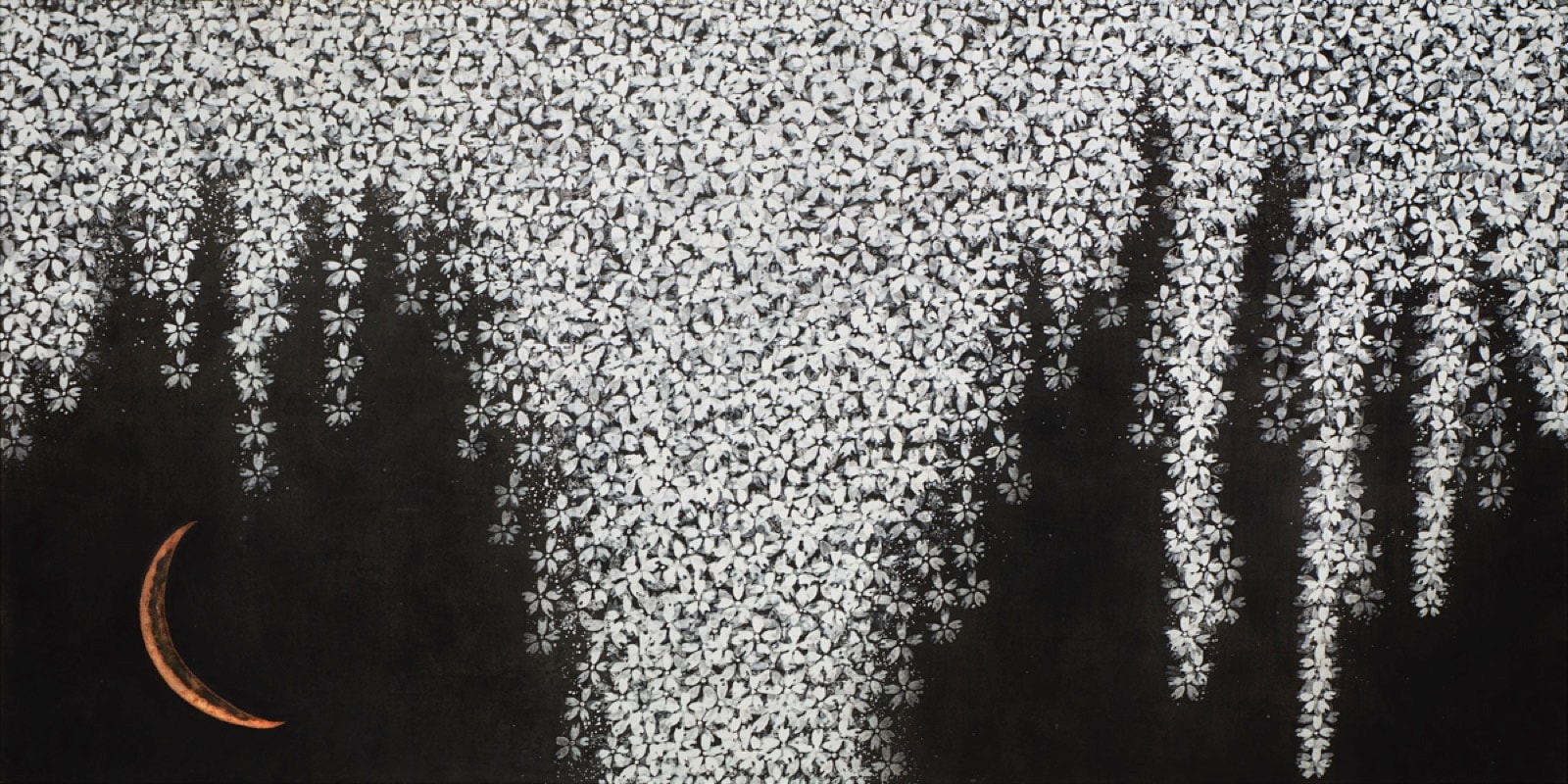
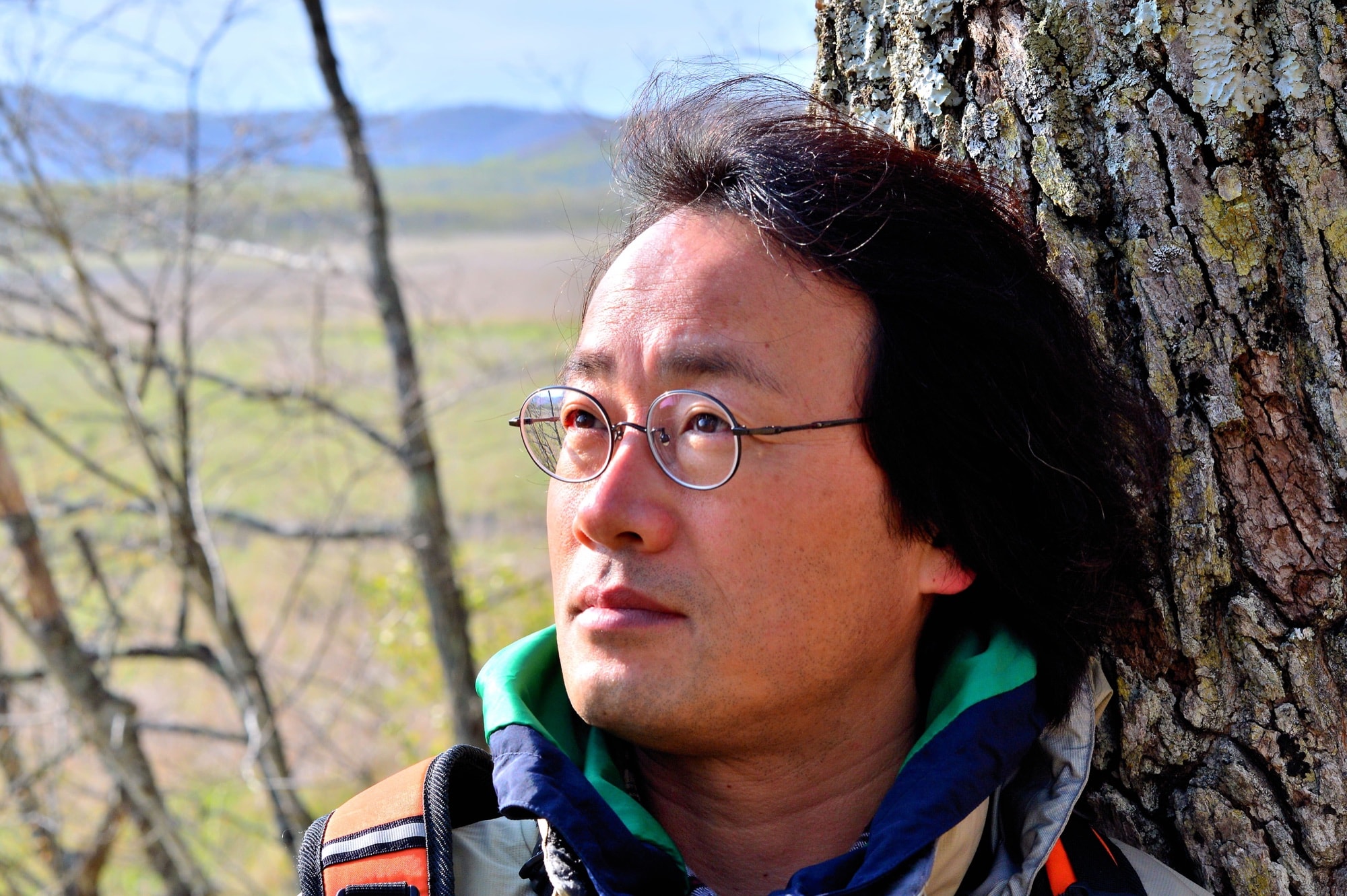
About Hiromitsu Kato
Born in Miyagi Prefecture in 1957. After completing graduate studies in Nihonga at Tama Art University, he built his practice from 2000 around two solo exhibitions a year, and also showed his work abroad, in New York, Paris, Madrid, Seoul and elsewhere. He is known for folding screens painted with tens of thousands of cherry petals. In February 2019 he brought a solo exhibition at the Hispano-Japanese Cultural Center of the University of Salamanca, Spain, to a successful close; shortly afterwards, in April of the same year, he died suddenly at his studio in Ranzan, Saitama Prefecture. He was 62.
The Japanese Spirit, Between East and West
Satoru Yamada (member of AECA, the Spanish Association of Art Critics, and AICA, the International Association of Art Critics)
“Beneath the cherry trees, corpses lie buried.”
This startling line is the opening of “Beneath the Cherry Trees”, a story by Kajii Motojirō (1901–1932). The protagonist is held captive by the beauty of the cherry blossom. And on the far side of that beauty he senses the presence of the ‘ugly’. Made uneasy by the cherry blossom’s overwhelming beauty, the protagonist imagines that
“The roots of the cherry trees, like greedy octopuses, are sucking up the liquid that drips like crystal from the corpses of animals and of human beings.”
So he imagines; yet it would not be at all surprising if this were the imagining of Kajii Motojirō himself, who died young, of tuberculosis, at thirty-one. Since ancient times the cherry blossom, in its overwhelming beauty and in the way that beauty scatters and is gone, has been a source of inspiration for the Japanese, at times fierce, at times decadent. And here, now, is another painter who draws his inspiration from the cherry blossom: Hiromitsu Kato.
He wanted to make art, but was unsure of the path to take, when by chance he walked into an exhibition of Nihonga; moved by the works, he chose this path. After entering art university he also studied Western painting, but his innate gifts were probably better suited to Nihonga. The materials of Nihonga do not lend themselves to works of great weight and density like those of Antonio López, the doyen of Spanish realism. So he set out to learn from the classics of Nihonga, and turned his attention to Itō Jakuchū (1716–1800), the “painter of the fantastic” who fused realism and imagination, and who was still largely unknown in Kato’s student days. His teachers treated him as an eccentric; yet the fact that Jakuchū is now accepted as a genius shows how keen Kato’s eye was. And the boldness he learned from Jakuchū, absorbing as well, probably without his knowing it, the essence of the Western painting he had studied at art university, appears in his works as a taste entirely his own. For with nothing but the tradition of Nihonga, which demands a certain degree of stylisation,
“I would no longer be able to express myself at all.”
For the works in this exhibition he took the cherry blossom as his motif. The cherry tree belongs to the landscape of his home, Miyagi; and for the Japanese it is also a landscape rooted deep in Japanese aesthetics through its beauty and its transience. It lies at the root of who Kato is, and at the root of who the Japanese are.
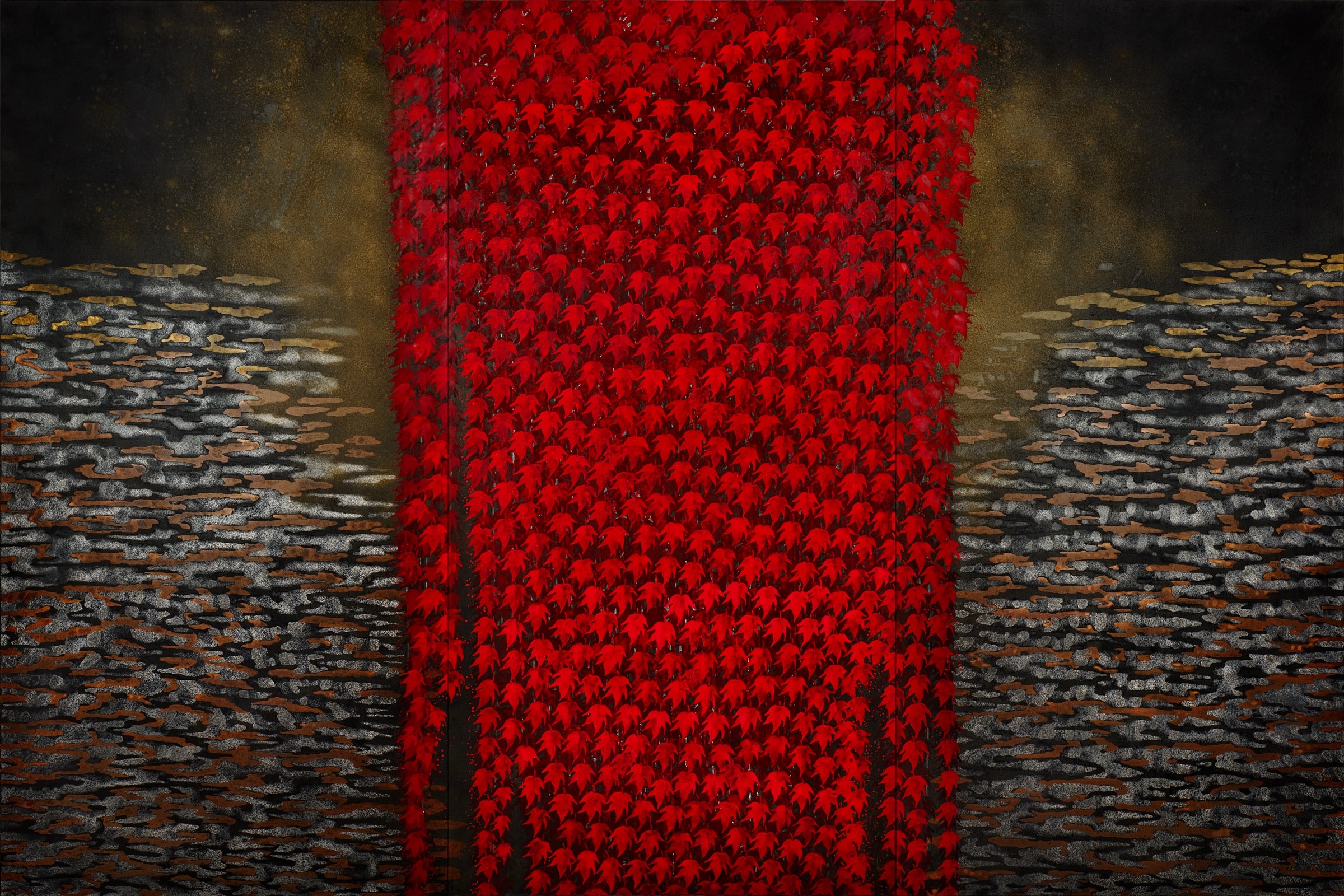
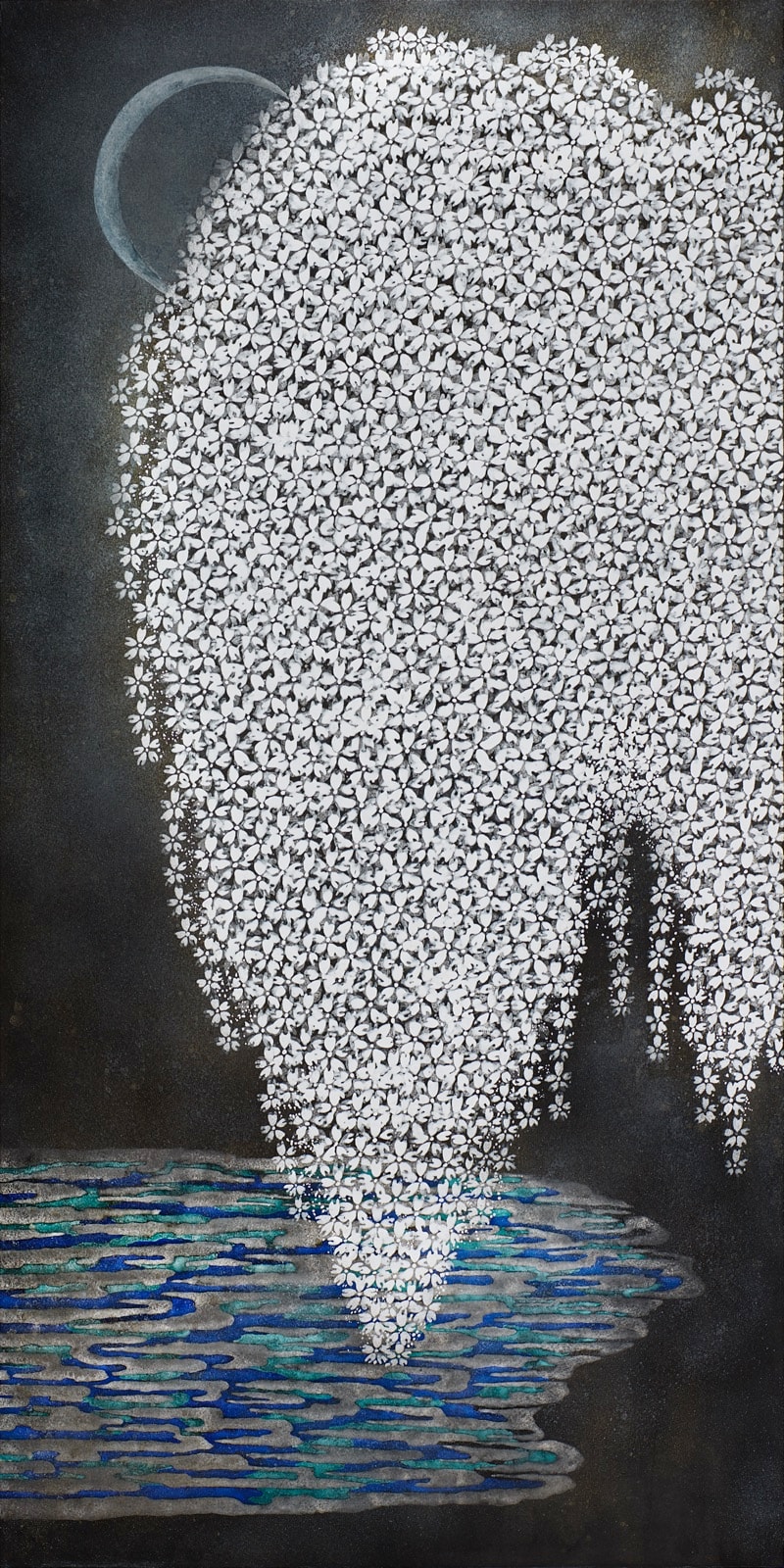
He leaves aside the tree as a whole and, boldly, paints the blossoms alone. Japan has a polytheistic culture, Shinto, in which a mystery can be found even in a single petal. That, says Kato, is precisely why this way of painting is legitimate too. The setting is usually night. The background is black. Kato’s black is beautiful. It is never the black of darkness. Within it, gold and silver are set faintly and by intuition, and to superb effect: each single cherry petal is brought forward. The position of the lights, or the daylight, even alters how the moon painted in the background appears. This magic of black offers the finest of stages on which the cherry blossoms, destined to vanish, burn out their lives in beauty.
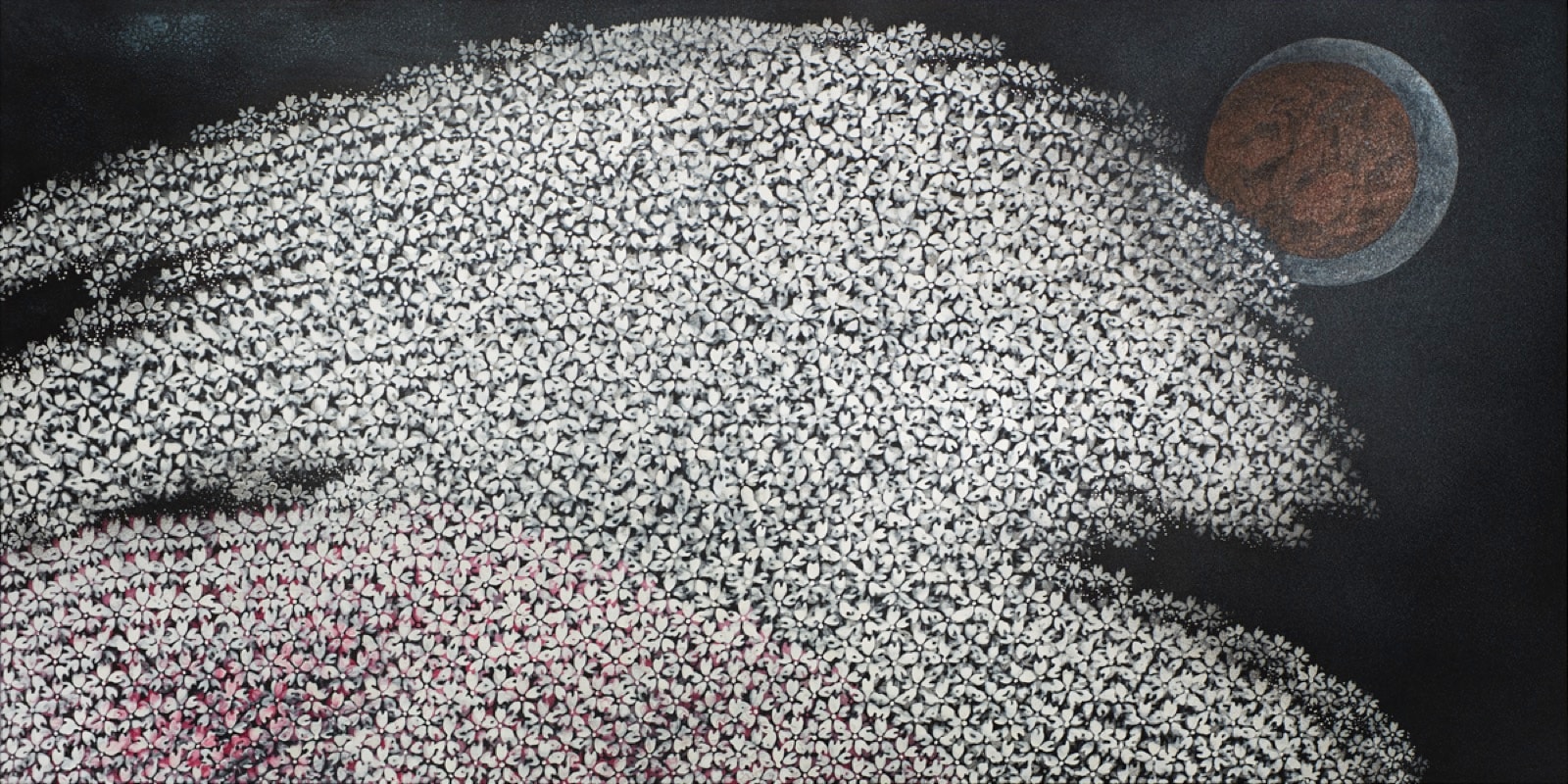
At first glance it may look like ordinary Nihonga, but the devices Kato has quietly worked into it are, without doubt, what creates the Kato style.
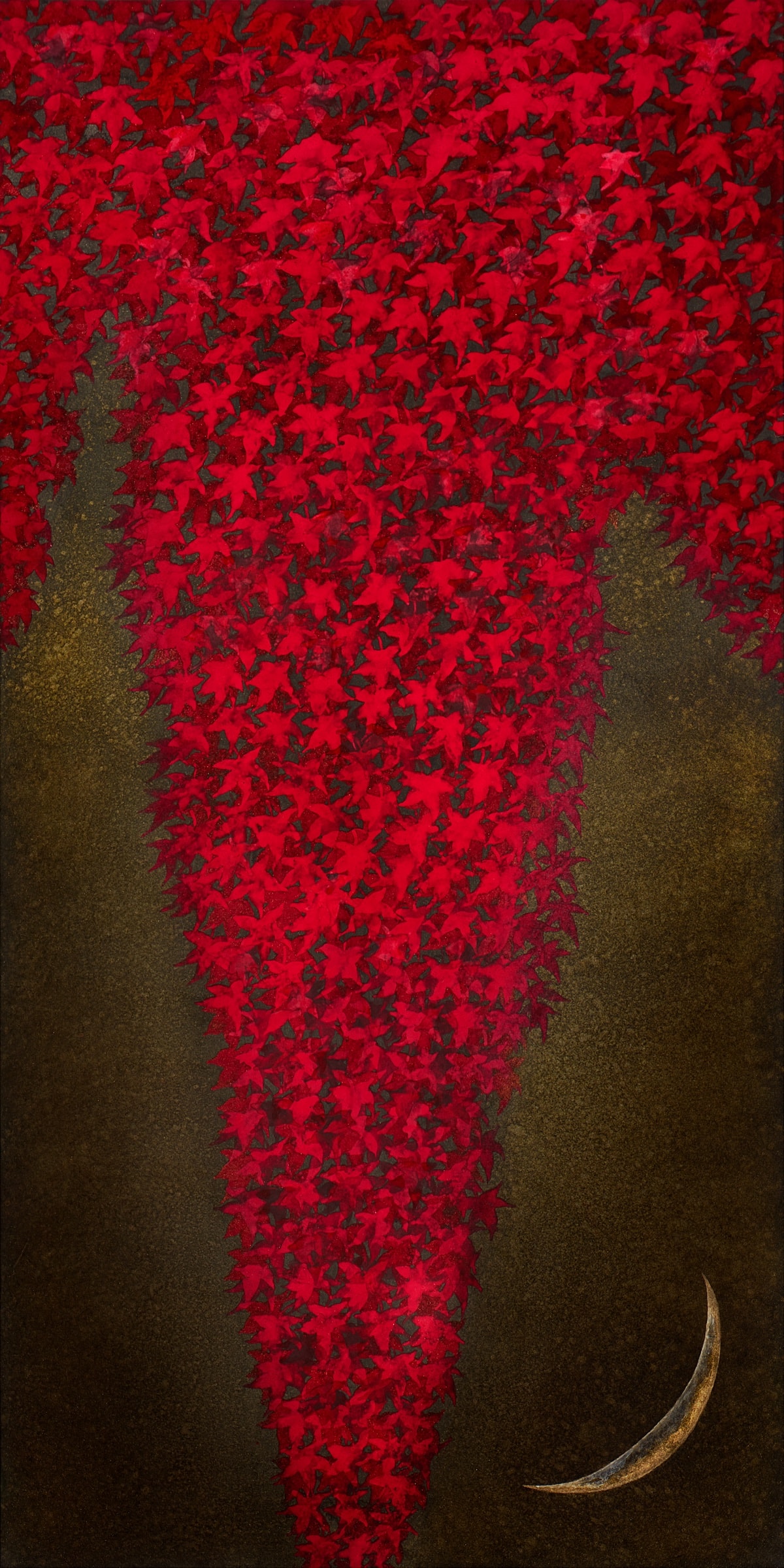
Beauty and death. It is precisely because they intuitively see ‘death’ in beauty that the Japanese are drawn to the beauty of the cherry blossom’s ‘life’. He has also painted autumn leaves and wisteria, and essentially the same can be said of them. The supreme moment of a life, revealed by that which is dying. I asked him what he wanted to do in Spain.
“I’d like to present my world in full. I want to take my time and see whether people can understand me.”
He may have come from the East to the West, but he has no intention of courting Western culture. How viewers feel is up to them. How will Westerners interpret his work? Will they, like the Japanese, see death in the cherry blossom? What will they see in the beauty of nature? I, too, look forward to finding out.
Hiromitsu Kato exhibition. Aula Magna “S.M. la Emperatriz Michiko”, Hispano-Japanese Cultural Center, University of Salamanca (Salamanca, Spain), 8 February – 7 March 2019
Recognition abroad (from 2009)
The flowers spring forward from a background of abstract texture, expressing release. The line is exact and keen, and the image has a decorative elegance like that of Klimt’s works.
— WALTER WICKISER GALLERY (New York, USA), Emil Memon (art critic)
Of the many painters who have come to Valencia, he is the one who conveys vision most forcefully. Like the ancient saints of the West in the Valencia art museum, and like a Western craftsman, he commands great skill, and he paints with his focus on the beauty within the mind. “In Japanese culture there is Buddhism; I find gods in nature, and I paint them,” he explains.
— From the newspaper ARTE Y LIBERTAD (Valencia, Spain)
Hiromitsu Kato’s works are made by meticulous handwork, like the techniques of ukiyo-e, a genre in which images of nature were created in Japan between the seventeenth and the twentieth centuries. Influenced by printmaking, Hiromitsu Kato pursues fragments of nature in depth and gives them expression, together with Western collage.
— From an appraisal of the exhibition by the Valencia Fine Art Centre (Spain)
He has superb technique and expressive power; he puts his whole being into every one of his works, and they are elaborately wrought. At ARCO (Europe’s largest art event) and in museums of contemporary art, what matters is to astonish with scale. From now on I want to lend my support and help to bring Hiromitsu Kato to ARCO.
— Paca Carsí (art critic, editor-in-chief of an art magazine)
Credits
- Text
- Satoru Yamada (member of AECA, the Spanish Association of Art Critics, and AICA, the International Association of Art Critics)
- Artist
- Hiromitsu Kato (1957–2019)
- Images
- Images of the works are reproduced with the permission of the artist’s family