Article
Hokusai’s fan paintings — three works painted in the shape of a fan
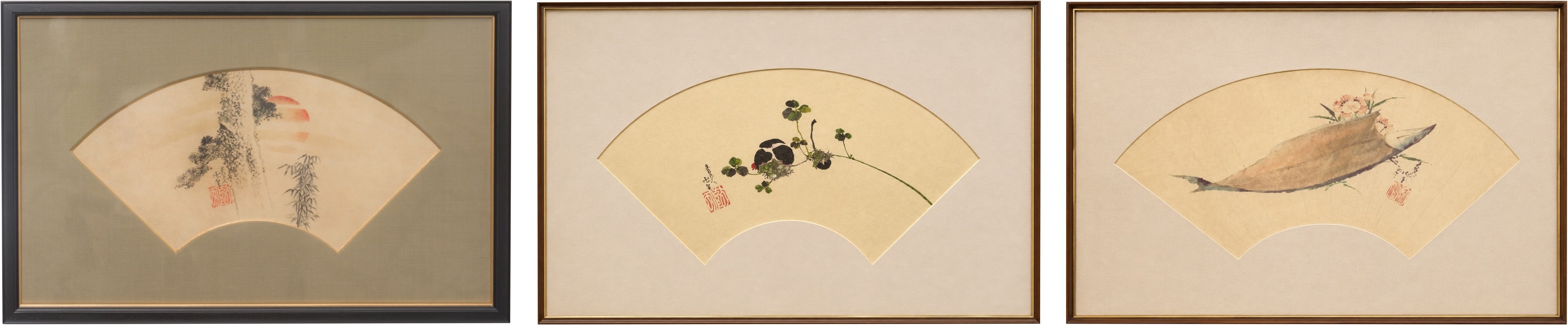
Hokusai’s paintings from his own brush are not confined to hanging scrolls and albums. Fan paintings survive too, painted on paper in the shape of an open folding fan. On a surface bounded by arcs, wide at the top and narrowing towards the bottom, what did Hokusai place, and where? We look at the three fans the gallery handles, one at a time.
Supervised by Yoshihisa Endo, Representative Director, Japan Art Academy
A surface bounded by arcs
A fan painting is a picture painted on paper in the shape of an open folding fan. The top edge is a large arc and the bottom edge a small one, while the two sides close diagonally, following the direction of the fan’s ribs. A composition cannot be built on vertical and horizontal lines as it can on a rectangular sheet; where each thing may be placed is itself governed by the shape of the fan.
All three of the gallery’s fans have been laid flat and framed. They were painted between Hokusai’s late seventies and the age of eighty-three, and together they let us compare how Hokusai, late in life, made use of this confined surface.
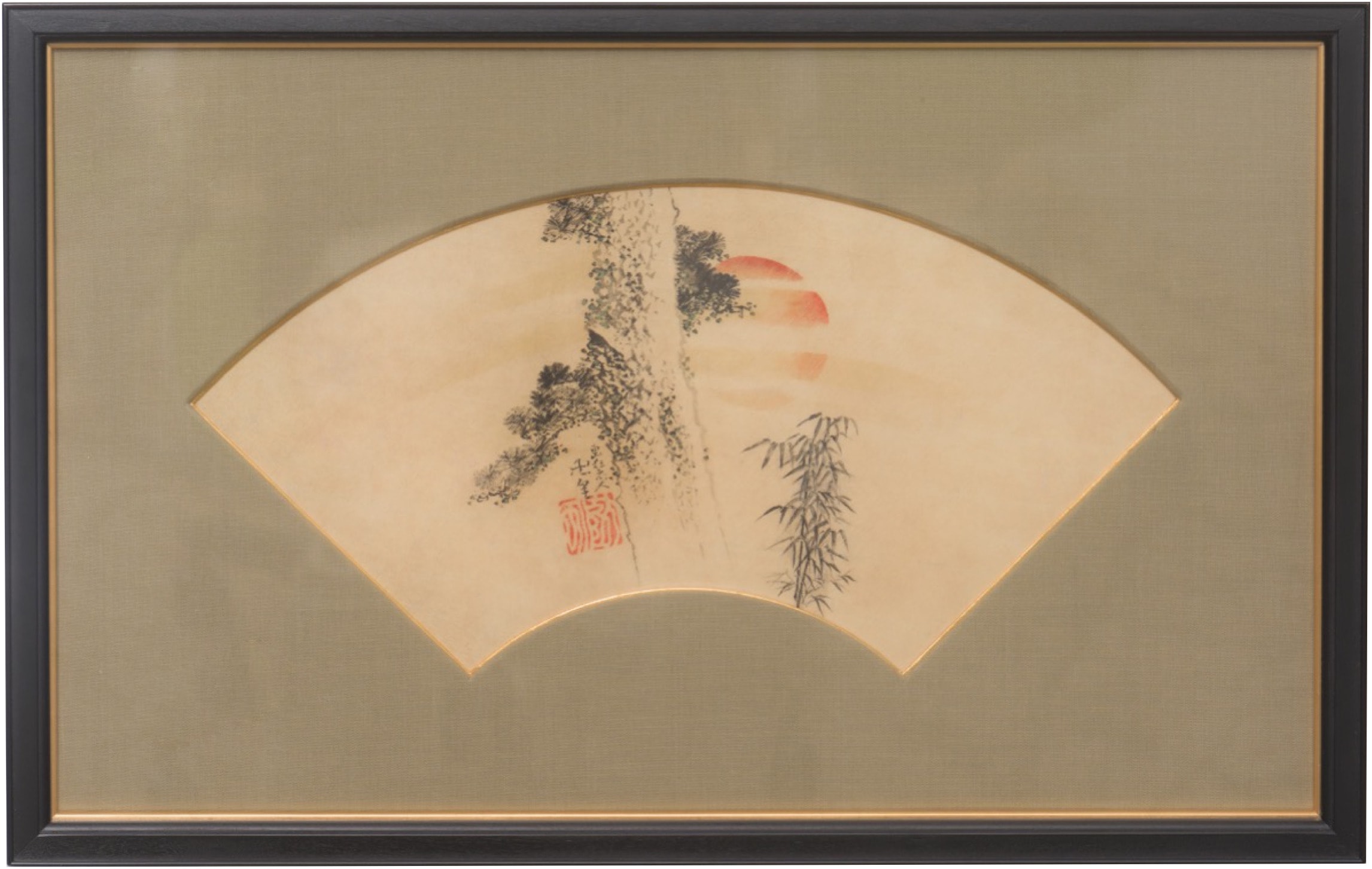
“Rising Sun and Pine” — a trunk cut off by the upper arc
Rising Sun and PineSold
旭日と松図
Ink and colors on Japanese paper
The old pine’s trunk stands at the centre of the fan and is cut off by the upper arc. This work is sold.
View this workThe trunk of an old pine rises at the centre of the picture, with a vermilion rising sun to its upper right and young bamboo growing up from the lower right. The trunk is cut off at the fan’s upper edge; it does not fit within the arc. That is why the pine seems to carry on beyond the picture.
The nearest thing is set large at the centre, and the subject beyond is glimpsed through the gaps around it. The documentation describes this way of composing as one Hokusai excelled at, and cites “Mishima Pass in Kai Province” from the Thirty-six Views of Mount Fuji, which is built in almost the same way. Across the trunk, the rising sun at upper right faces the vermilion of the seal at lower left; the red, divided between two places, holds the picture together.
The signature reads “brush of Gakyo Rojin Manji,” with a square seal in white characters reading “Katsushika.” From a habit of the hand — the final stroke of the character for “brush” flicks slightly up to the right — and from the period in which this seal was in use, the documentation estimates that the fan dates from Hokusai’s late seventies. Old pine, young bamboo and rising sun are all auspicious motifs, and in the documentation’s view the fan was very likely painted to order for a celebration.
“Small Eggplants and Wild Strawberries” — a single runner reaching to the right edge
Small Eggplants and Wild Strawberries
小茄子に野苺図
Ink and colors on Japanese paper
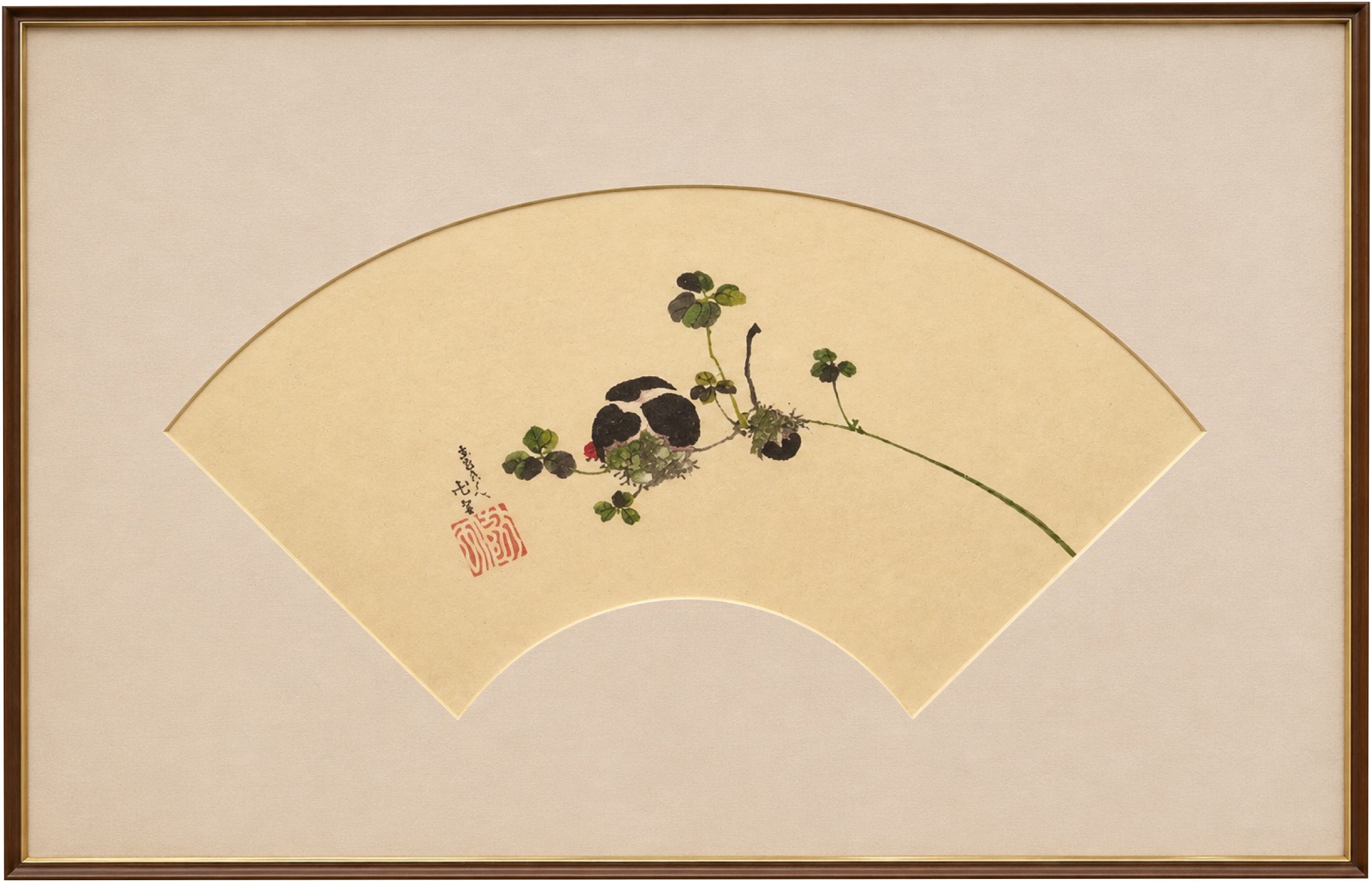
Fruit and leaves are gathered in the middle; only the runner travels far, all the way to the right edge.
View this workSmall eggplants split open, and a mock strawberry sending out its runner. The fruit and leaves are gathered in the middle of the fan, a little to the left, and only a single runner stretches down to the right, as far as the fan’s right-hand edge. A wide empty space is left open, and one line crosses it.
According to the documentation, this too was painted in Hokusai’s late seventies. A painting of the same subject is in the Freer Gallery of Art, Washington.
“Dried Saury and Pinks” — one fish laid diagonally across the fan
Dried Saury and Pinks
秋刀魚と撫子図
Ink and colors on Japanese paper
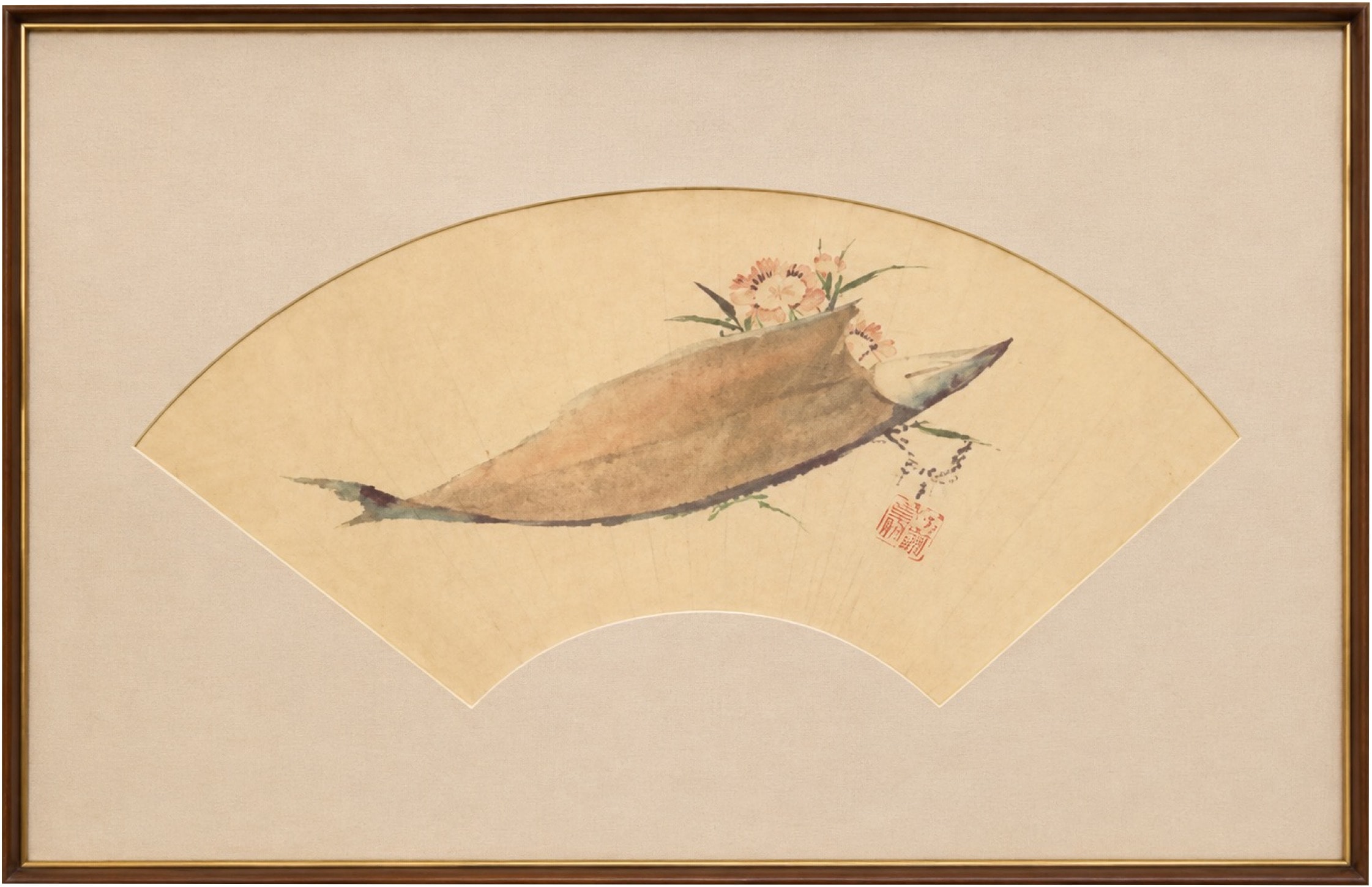
A butterflied saury is set large and on the diagonal across the middle of the fan, with pinks behind it.
View this workA single butterflied saury lies diagonally across the fan, from lower left to upper right. The line of the fish’s body does not follow the arcs of the fan; it is set as one diagonal running against them, and behind it the flowers of the pinks show through. The pale flesh of the dried fish, the soft pink of the flowers: a seasonal pairing, held within a single fan.
It was painted by Hokusai at eighty-three. According to the documentation, it was formerly owned by Francis Lathrop, an American stained-glass artist active in the latter half of the 19th century, and it came to light again after some 120 years.
The three side by side
What the three share is that none of them works around the shape of the fan; each puts it to use. The trunk is cut off by the upper arc, the runner is drawn out to the very edge on the right, the fish is laid on a diagonal against the arcs. The edges of a confined surface become the starting point of the composition itself.
We welcome enquiries about acquiring “Small Eggplants and Wild Strawberries” and “Dried Saury and Pinks.” If you would like to see either work in person or ask about its condition, please get in touch through our enquiry page.
Supervising editor
Yoshihisa EndoJapan Art Academy Representative Director
Born in Nishi-Azabu, Tokyo, in 1940. After graduating in French literature from Chuo University and a period in business, he founded a video production company. Negotiating directly with the Louvre, the Prado, the Hermitage and other museums, he filmed their collections in high definition for series such as The Museums of the World (1991), and published a multi-volume museum encyclopedia with twenty professors led by the art historian Seiro Maekawa.
He has produced or supervised more than a thousand television programmes on art (The World's Masterpieces on BS Asahi and Painter × Painter on BS Nippon TV among them), and his books include Letters from Vermeer and Lautrec and Mucha (Random House Kodansha) and a study of the Hokusai Manga (Kawade Shobo Shinsha). He is representative director of the Japan Art Academy (founded 2010) and a director of the International Hokusai Society (founded 2019). As a filmmaker he works under the name Hisashi Fuji.