Article
The provenance of Picasso’s L’enfant à l’orange — from the artist’s family onward
When you are deciding whether to bring a painting home, the road it has travelled deserves checking alongside the painting itself. Whose hands has Picasso’s L’enfant à l’orange passed through, where has it been shown, and in which books has it appeared? Here we set out, in date order, only what is recorded in the documentation that accompanies the work.
1951: Paloma, the youngest daughter
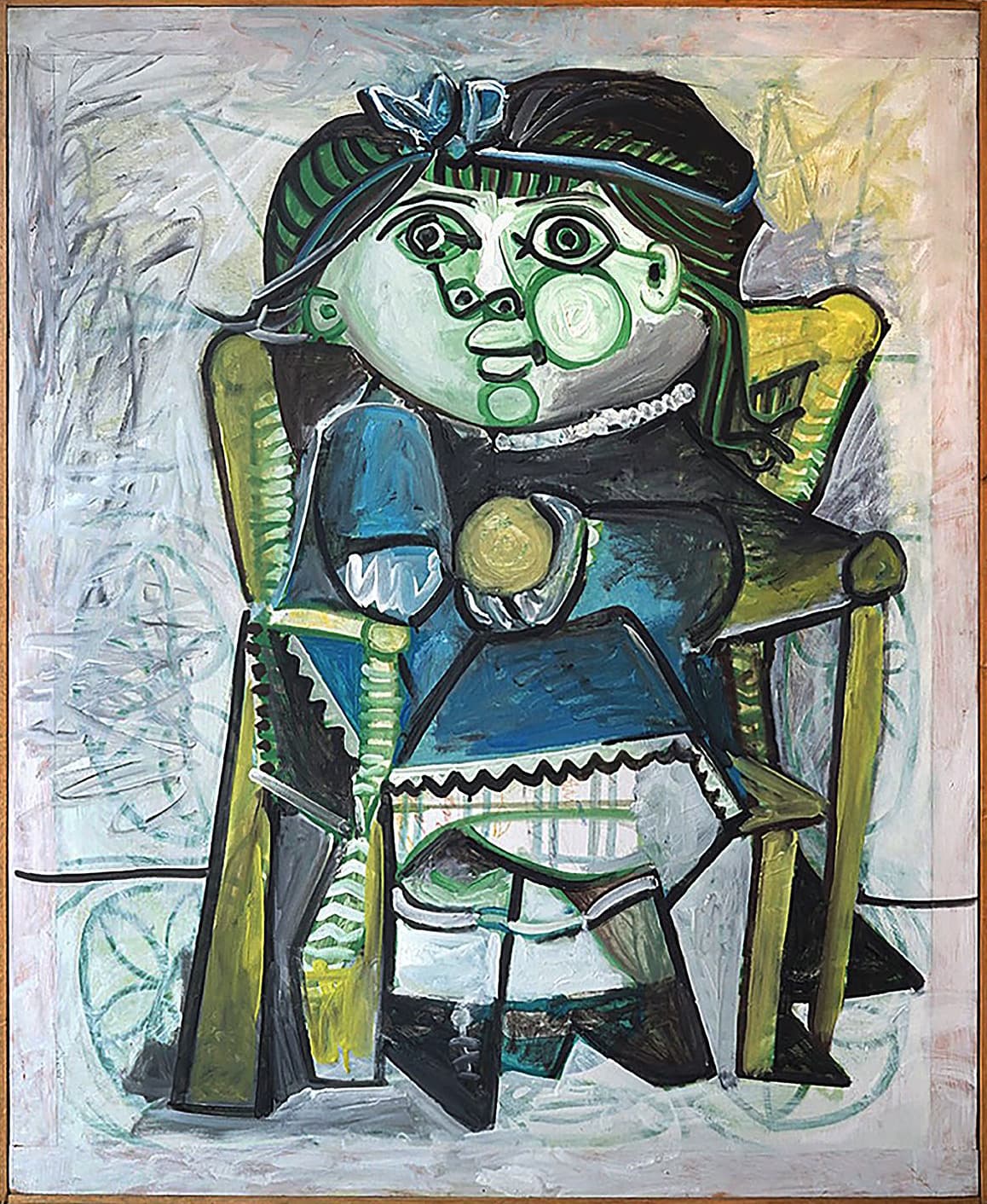
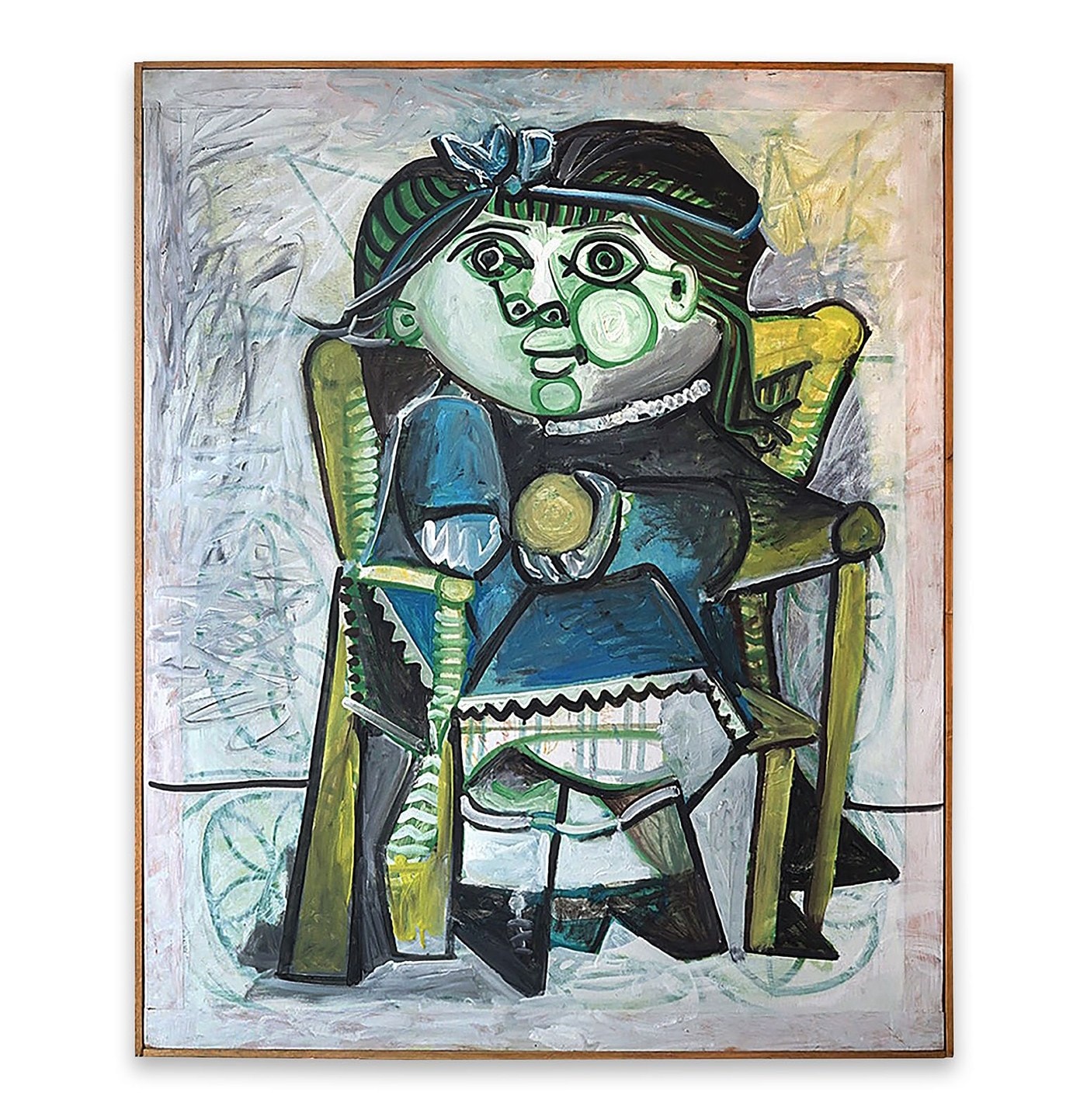
L’enfant à l’orange is Picasso’s 1951 painting of his youngest daughter, Paloma. It is painted in enamel on plywood and measures 108 × 89 cm. On the reverse it is dated “9.1.51.” Paloma was born in 1949.
From the Blue and Rose periods to the portraits of his last years, Picasso painted children throughout his career. The documentation notes that his paintings of his own children — Paul (born in 1921), Maya (1935), Claude (1947) and Paloma (1949) — are among the most intimate and exuberant of his work. This painting is a portrait of the youngest of them.
Provenance — three names on record
The documentation records three owners.
The first is Claude Picasso, Paris: the artist’s son, born in 1947, and the elder brother of Paloma (born in 1949), the child in the painting. The documentation also includes a photograph of Picasso with his children, Claude and Paloma, taken at Vallauris, France, in 1953.
Next came Galerie Gmurzynska, Zug, Switzerland. Then, in 2006, the painting passed from that gallery into a private collection.
Exhibitions — 1953 to 2003
In 1953, two years after it was painted, the work was shown in the Picasso exhibitions held at the Galleria Nazionale d’Arte Moderna in Rome (May–July, no. 113) and at the Palazzo Reale in Milan (September–November, no. 154). It is illustrated in both catalogues.
From November 1966 to February 1967 it was shown in Hommage à Pablo Picasso at the Grand Palais, Paris (no. 221), and then, in March–April 1967, in the Picasso exhibition at the Stedelijk Museum, Amsterdam (no. 108). The Amsterdam catalogue carried a colour reproduction of this painting on its cover. All four of these exhibitions took place in the artist’s lifetime (Picasso died in 1973).
In 1996 it was included in Picasso and Portraiture: Representation and Transformation at the Museum of Modern Art, New York (April–September), and reproduced in colour on page 432 of the catalogue. There it was titled Paloma with an Orange. Among the records in the documentation, this exhibition is the only one noted with a different title. The exhibition then travelled to the Grand Palais, Paris (October 1996–January 1997).
In February–May 2003 it was shown in Picasso: From Caricature to Metamorphosis of Style at the Museu Picasso, Barcelona (no. 207, pp. 198–199, illustrated in colour).
Literature — five books
The documentation lists five books in which the work is reproduced: Aragon’s Picasso: Deux périodes, 1900–1914 & 1950–1954 (1954, no. 28); P. Daix’s Picasso (1965, p. 201); J. Leymarie’s Picasso: The Artist of the Century (1972, p. 267); P. Descargues’s Picasso (1974, p. 104, illustrated in colour); and C. Zervos’s Pablo Picasso: Works from 1946 to 1953, vol. XV (Cahiers d’Art, 2013, no. 175, pp. 104 and 166).
A painting of the same title by Van Gogh
Vincent van Gogh also painted a picture of the same name, L’Enfant à l’Orange, or Child with an Orange (1890, oil on canvas, 50 × 51 cm). The documentation includes a reproduction of it as well, but it is a different work from this one; the artist and the date tell them apart.
Details of the work and enquiries
The image of the work, together with full lists of its provenance, exhibitions and literature, is on the work’s own page. To see the painting in person or to discuss its price, please get in touch through our enquiry page.
View the page for L’enfant à l’orange