Article
The Edo table and Hokusai: salmon, dried squid, daikon
Not famous places, not beauties: Hokusai painted what was in the kitchen. A slice of salmon, dried squid, a single saury. Each looks like ordinary food, and yet for the people of Edo none of it was easy to come by.
Supervised by Yoshihisa Endo, Representative Director, Japan Art Academy
When salmon was a treat
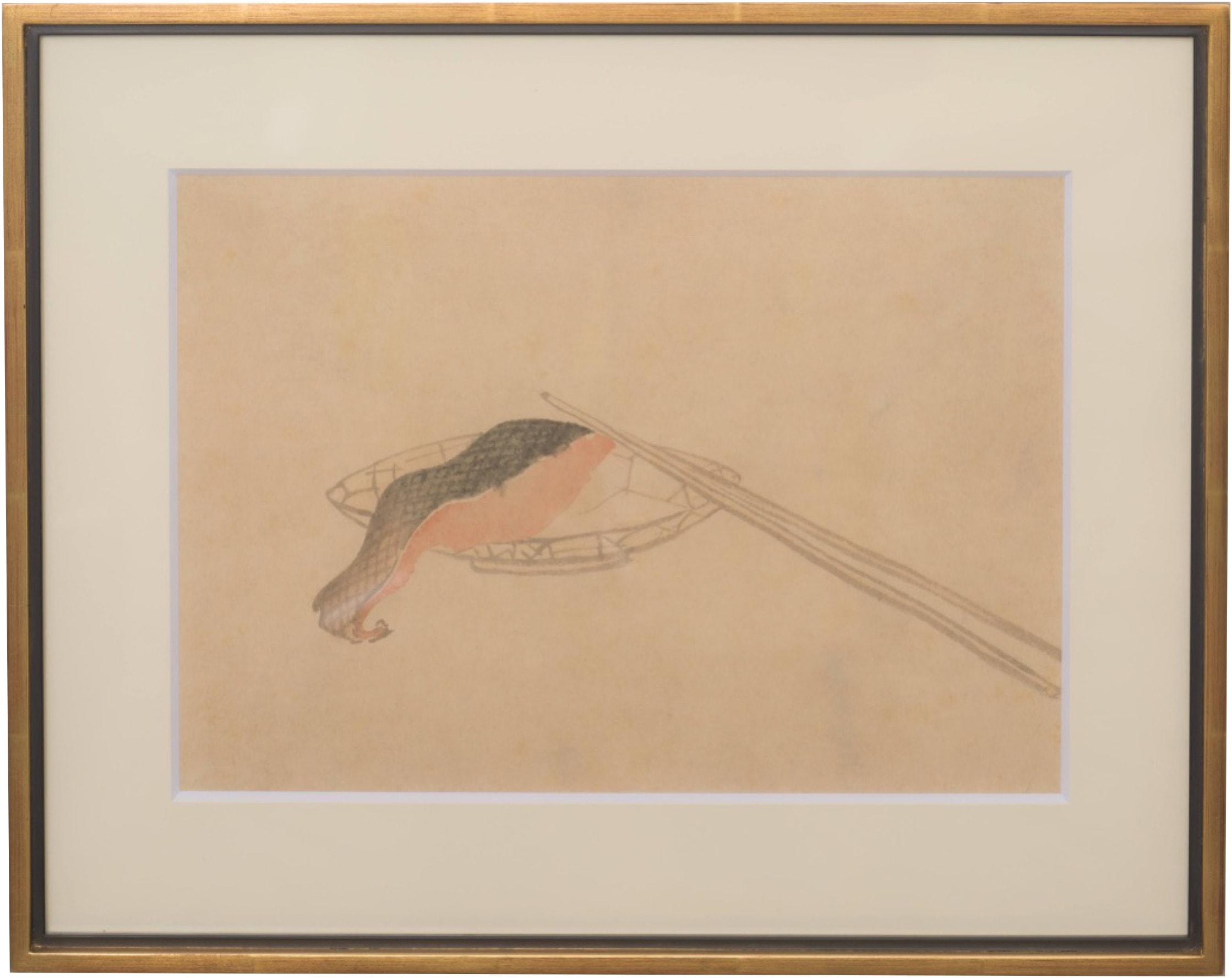
Slice of Salmon
鮭の切身図
Ink and colors on Japanese paper 24.1 × 34.0 cm
A slice of salmon, drawn with the briefest of brushwork.
View this workA single slice, simply laid down. That is the whole picture.
But in the Edo period salmon was not a fish that ordinary people ate every day. Before salted salmon began arriving in quantity from Ezo — present-day Hokkaido — it was a precious food. Salt itself was expensive, so even salted salmon was anything but commonplace until around the middle of the period.
This slice, in other words, is a delicacy. Seen that way, it is all the more surprising that the picture consists of a few lines following the grain of the flesh and a faint gradation at the edge of the skin. Hokusai did not paint precious things preciously.
Dried things that bound people together
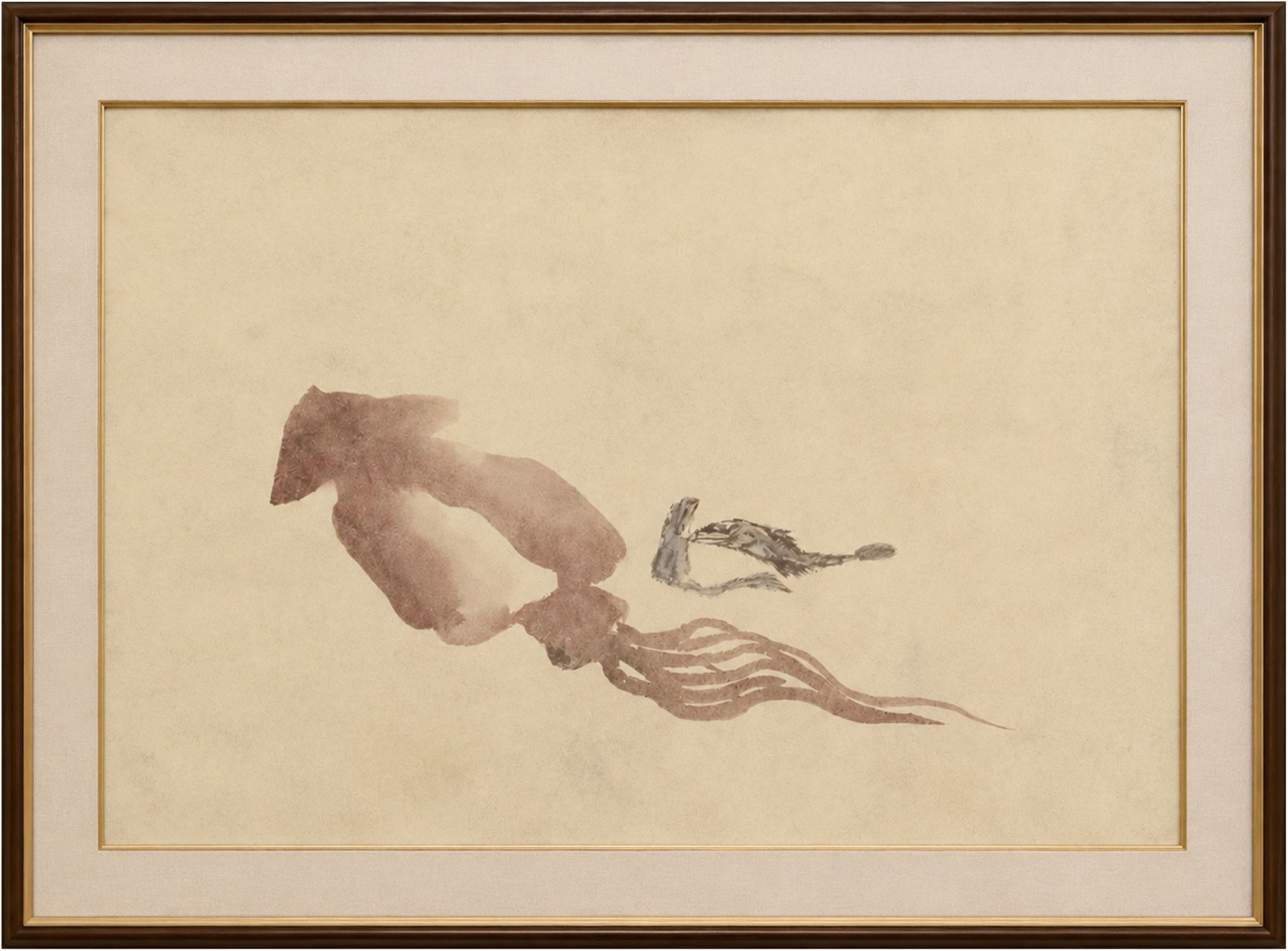
Dried Squid and Small Fish
するめと雑魚図
Ink and colors on Japanese paper 24.1 × 34.0 cm
Everyday food, and at the same time a gift.
View this workSurume is dried squid; zako are small fish. Both keep for a long time, and both sustained the daily table.
But they were not only that. Dried seafood was given as a present and served at celebrations; it bound people to one another. For ordinary households it could also be a rare treat, even a luxury.
The same album contains a block of dried bonito tied with mizuhiki — the red-and-white cords tied around a formal gift. Food becomes the very shape of a celebration. The table of Edo stood far closer to ritual than ours does.
A wish placed in the things of the kitchen
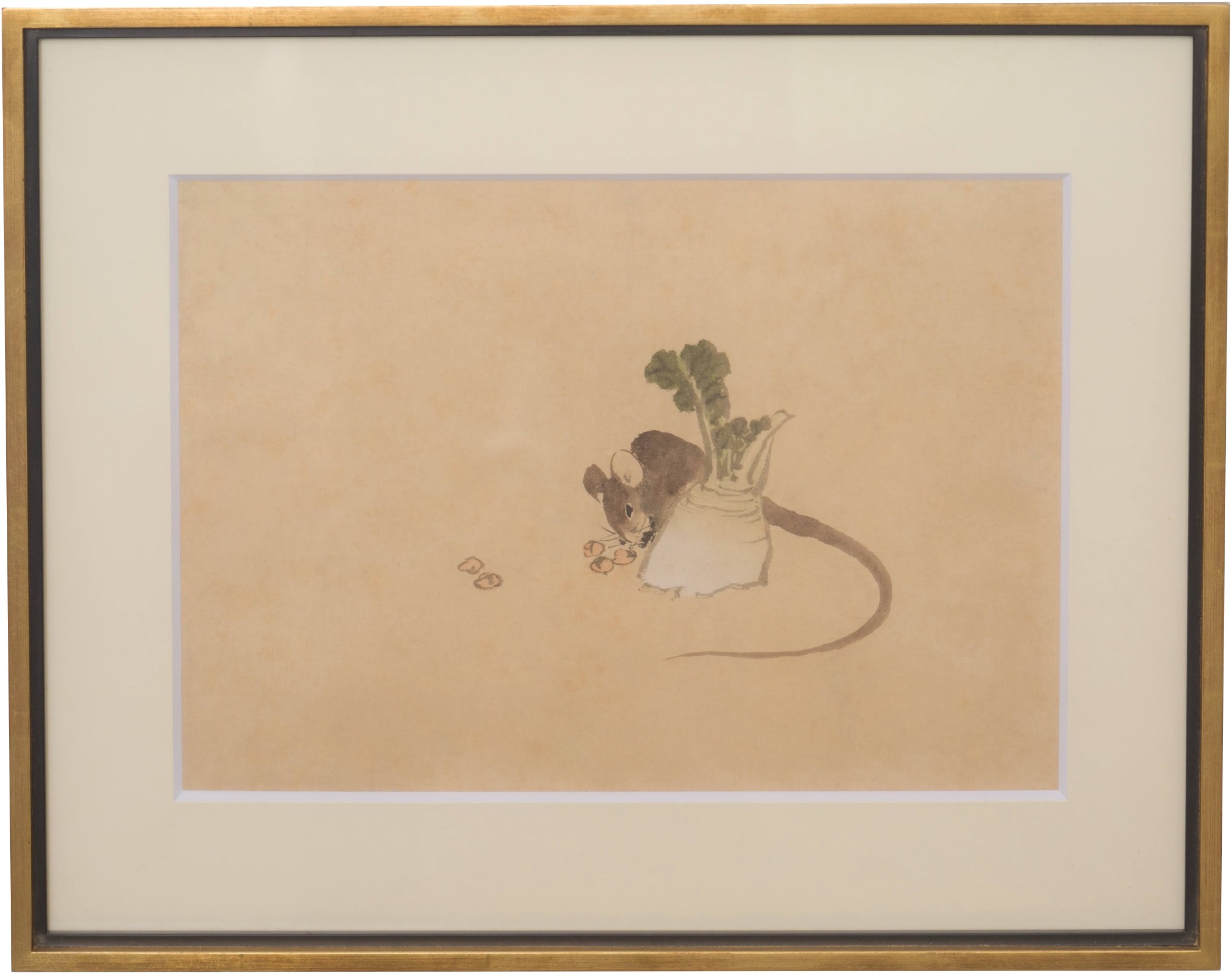
Rat and Daikon Radish
鼠大根図
Ink and colors on Japanese paper 24.1 × 34.0 cm
A daikon and a mouse: an auspicious pairing that recurs in the painting and craft of Edo.
View this workA mouse set beside a daikon is thought to draw on the myth of Ōkuninushi and the mouse. In the Kojiki, Ōkuninushi is trapped by a grass fire with nowhere to flee, and a mouse saves him. Ōkuninushi later came to be identified with Daikokuten, one of the seven gods of good fortune, and the pairing of his messenger the mouse with the daikon came to be called the “Daikoku mouse” — an image of good fortune.
It is a combination that appears again and again in the painting and decorative arts of the Edo period, and Hokusai was fond of it, leaving several works on the same conceit.
What is in the kitchen becomes the shape of a wish. He paints food and, at the same moment, paints good fortune.
The one fish an eighty-three-year-old chose
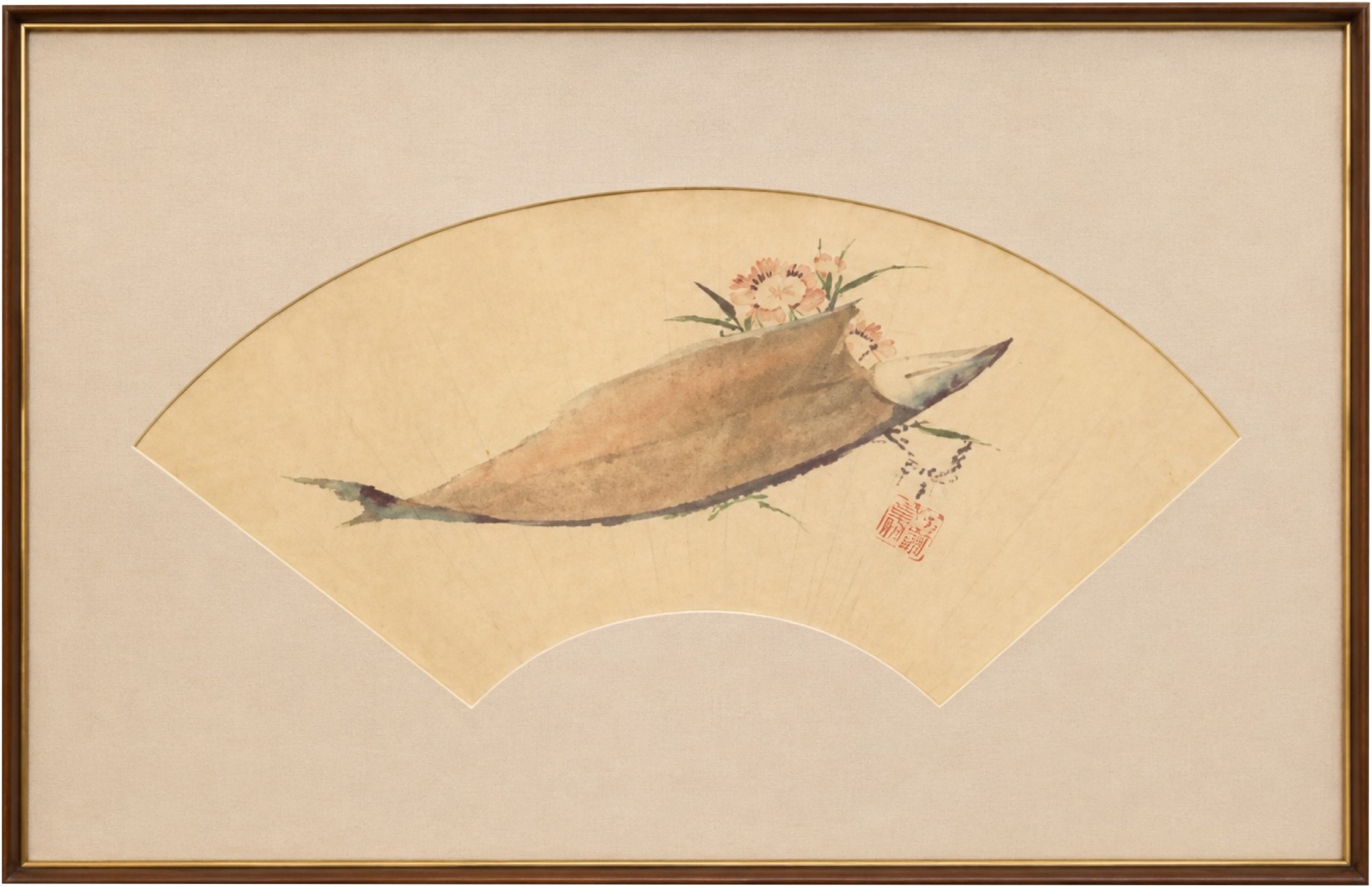
Dried Saury and Pinks
秋刀魚と撫子図
Ink and colors on Japanese paper 18.4 × 50.5 cm
A split-open saury with pinks, on a fan. The brush of an eighty-three-year-old.
View this workAt eighty-three, what Hokusai painted was a saury split open for drying, and a pink. The pink is a pale red flower of the autumn fields. The picture is painted on paper cut in the shape of a fan — such works are called senmenga, fan paintings.
A dried fish and a wild flower. That is enough for a whole autumn to rise. After a long life in which he had painted everything, this is what he reached for: one saury. The gaze the aged Hokusai turned on ordinary things is plain to see in it.
Hokusai from the kitchen
Salmon, dried squid, daikon, saury: for Hokusai these carried the same weight as Mount Fuji or a beauty. He took what everyone knew and drew it properly, with a brush that left things out.
What the people of Edo looked at and thought a luxury, we now look at in the same picture. We are glad to arrange viewings of these paintings and to discuss their purchase.
Supervising editor
Yoshihisa EndoJapan Art Academy Representative Director
Born in Nishi-Azabu, Tokyo, in 1940. After graduating in French literature from Chuo University and a period in business, he founded a video production company. Negotiating directly with the Louvre, the Prado, the Hermitage and other museums, he filmed their collections in high definition for series such as The Museums of the World (1991), and published a multi-volume museum encyclopedia with twenty professors led by the art historian Seiro Maekawa.
He has produced or supervised more than a thousand television programmes on art (The World's Masterpieces on BS Asahi and Painter × Painter on BS Nippon TV among them), and his books include Letters from Vermeer and Lautrec and Mucha (Random House Kodansha) and a study of the Hokusai Manga (Kawade Shobo Shinsha). He is representative director of the Japan Art Academy (founded 2010) and a director of the International Hokusai Society (founded 2019). As a filmmaker he works under the name Hisashi Fuji.
The Japan Art Academy (founded 2010), which plans and supervises this series, works in art film and publishing, and established the International Hokusai Society in 2019. Based in Nihonbashi Odenma-cho, Tokyo, it carries out research on Hokusai's hand-painted works and compiles catalogues of them, and supervises the colour of the reissued Thirty-six Views of Mount Fuji printed by Takahashi Kobo. In 2026 it published Exploring the Appeal of Hokusai's Original Paintings, a catalogue of hand-painted works that includes pieces never shown before, edited and written by its executive director, Hiromi Yasui.
Credits
- Planning and materials
- International Hokusai Society, Japan Art Academy
- Supervision
- Yoshihisa Endo, Representative Director, Japan Art Academy