Article
The Famine of 1836 and the Album of Twelve
What if the pictures painted in a year of famine turned out to be auspicious ones? In these twelve small sheets, the way a painter of seventy-seven got through that year is still there to be seen.
Supervised by Yoshihisa Endo, Representative Director, Japan Art Academy
What was written on the cover
The twelve sheets were once bound together. Pictures pasted in sequence and made up as a book: that is an album, a gajō. They are not prints. Hokusai laid the brush directly on the paper, and paintings of this kind are called nikuhitsuga — works from the artist’s own hand.
On the cover was a title slip, a daisen: the narrow strip of paper that carries the title, as a spine does on a book. It reads:
“In the seventh year of Tenpō, the year of the fire monkey, a great famine struck the provinces of Japan and many fell in the roads. At that time the old man Hokusai, seventy-seven years of age, devised this album of paintings from his own hand, and by it, it is said, he barely kept himself fed.”
The seventh year of Tenpō is 1836. Famine had spread across the country and people were collapsing in the streets. That year, at seventy-seven, Hokusai thought of this album and barely kept himself fed.
He painted in order to eat. The Thirty-six Views of Mount Fuji had appeared a few years earlier and his name was known across the country. And here he is, at seventy-seven, taking up the brush for that day’s rice. Each sheet measures 24.1 by 34.0 centimetres, small enough to hold in both hands. These were not grand works for an alcove, but pictures meant to pass, one at a time, into other people’s hands.
What would sell?
The range of subjects across the twelve is startling.
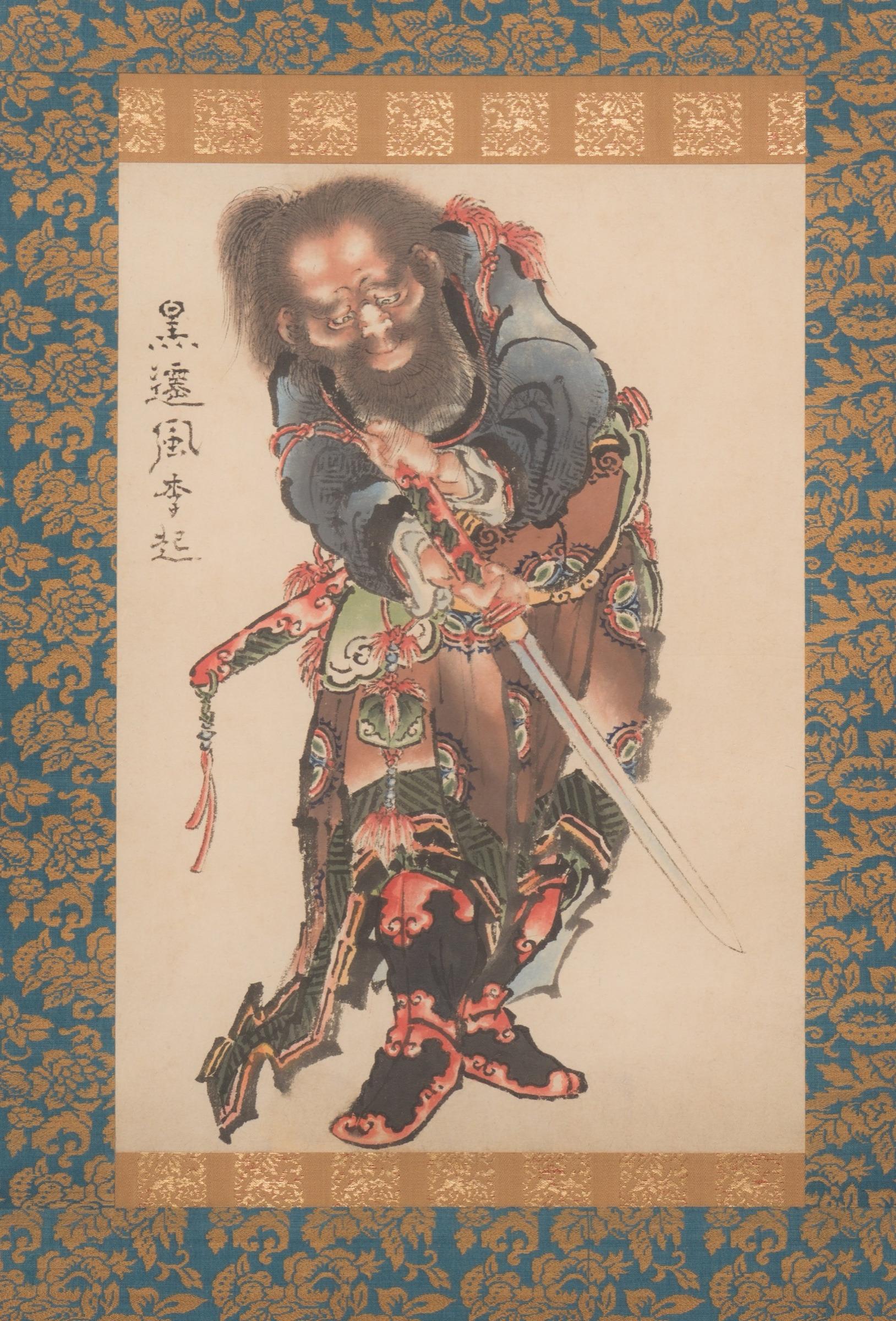
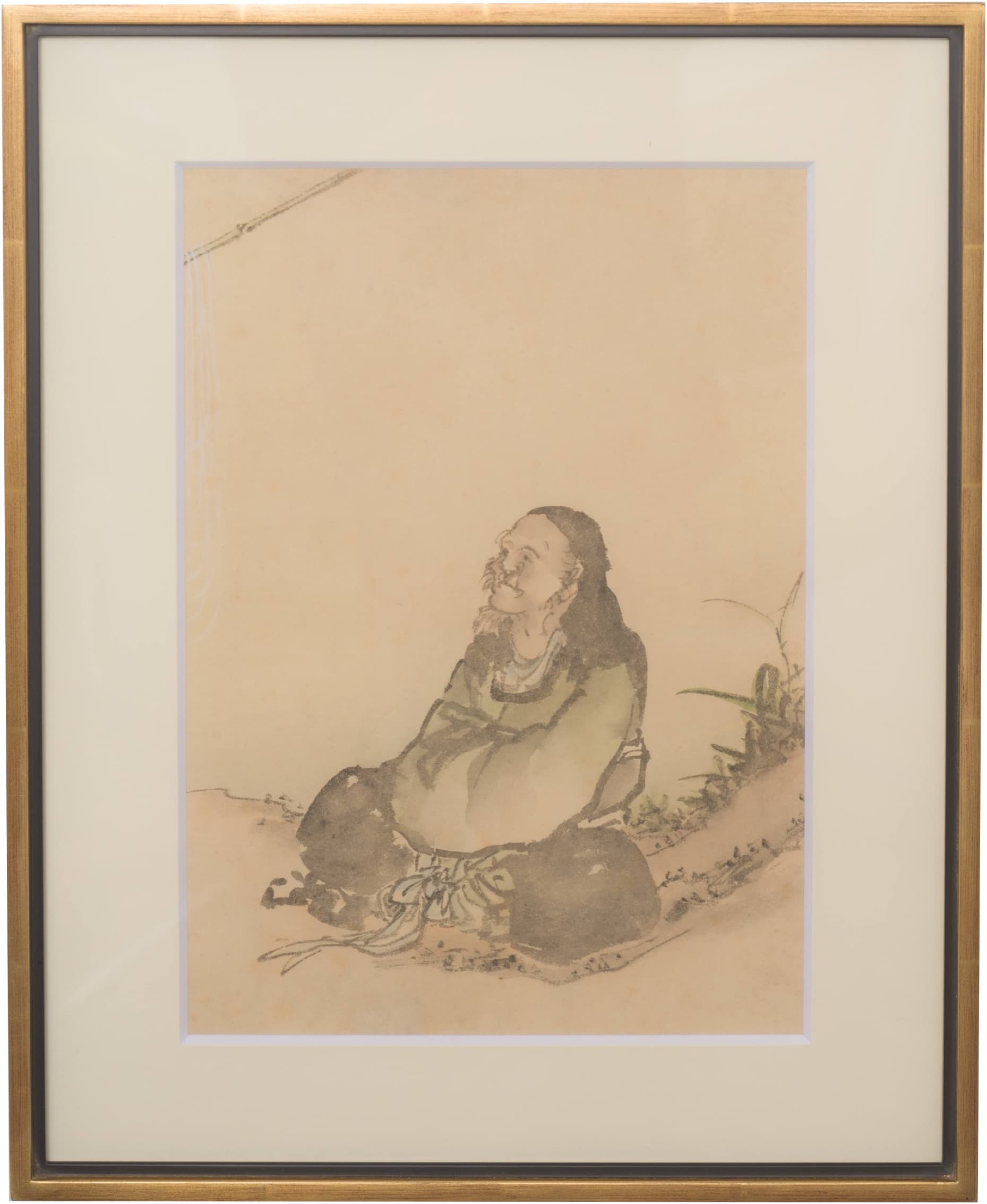
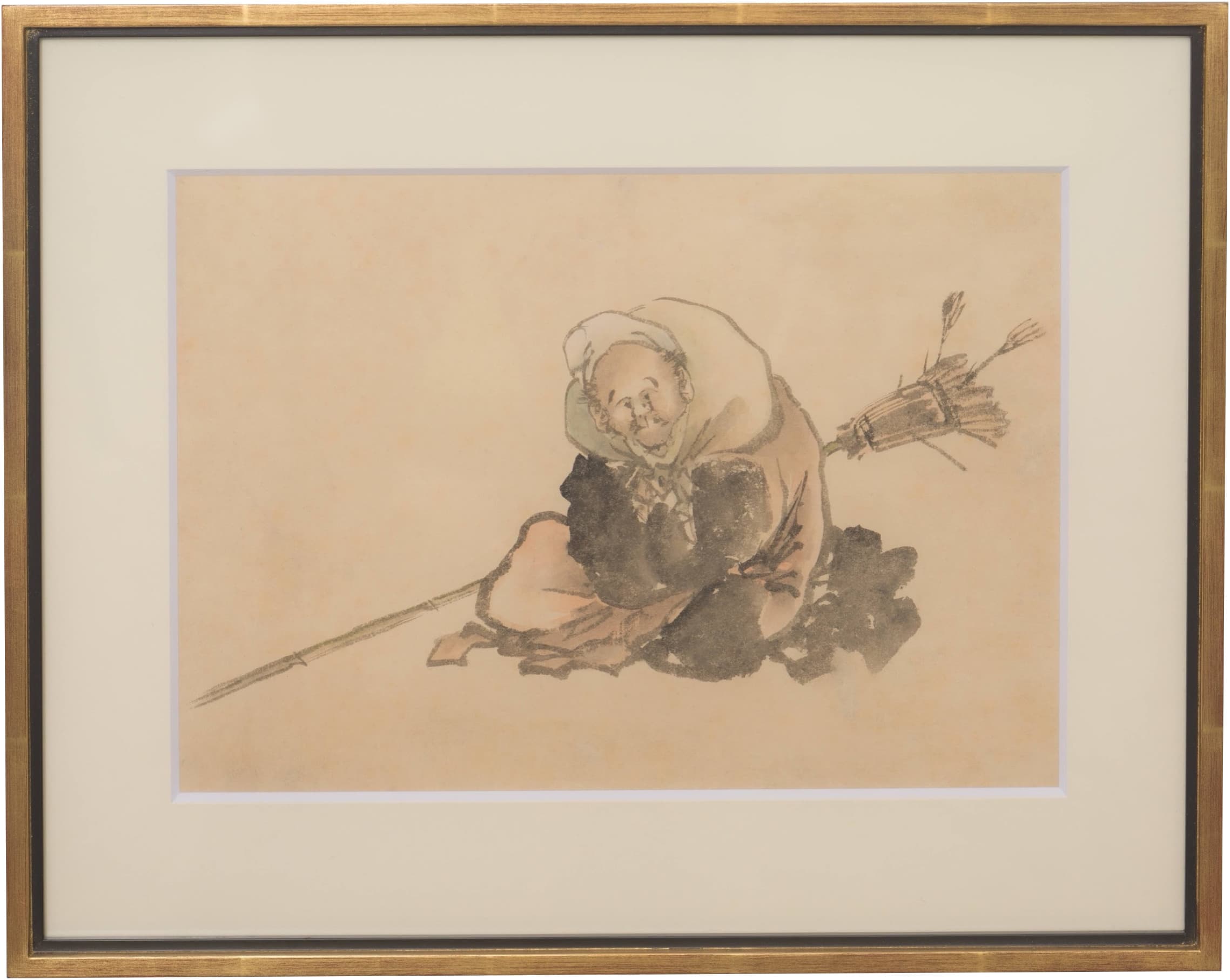
Four are figures: Li Kui, the brawling hero of the Chinese novel Water Margin; Confucius, the Chinese thinker; Hotei, one of the seven gods of good fortune, with his great sack; and a tea-whisk peddler, who went from street to street selling the bamboo whisks used to make matcha.
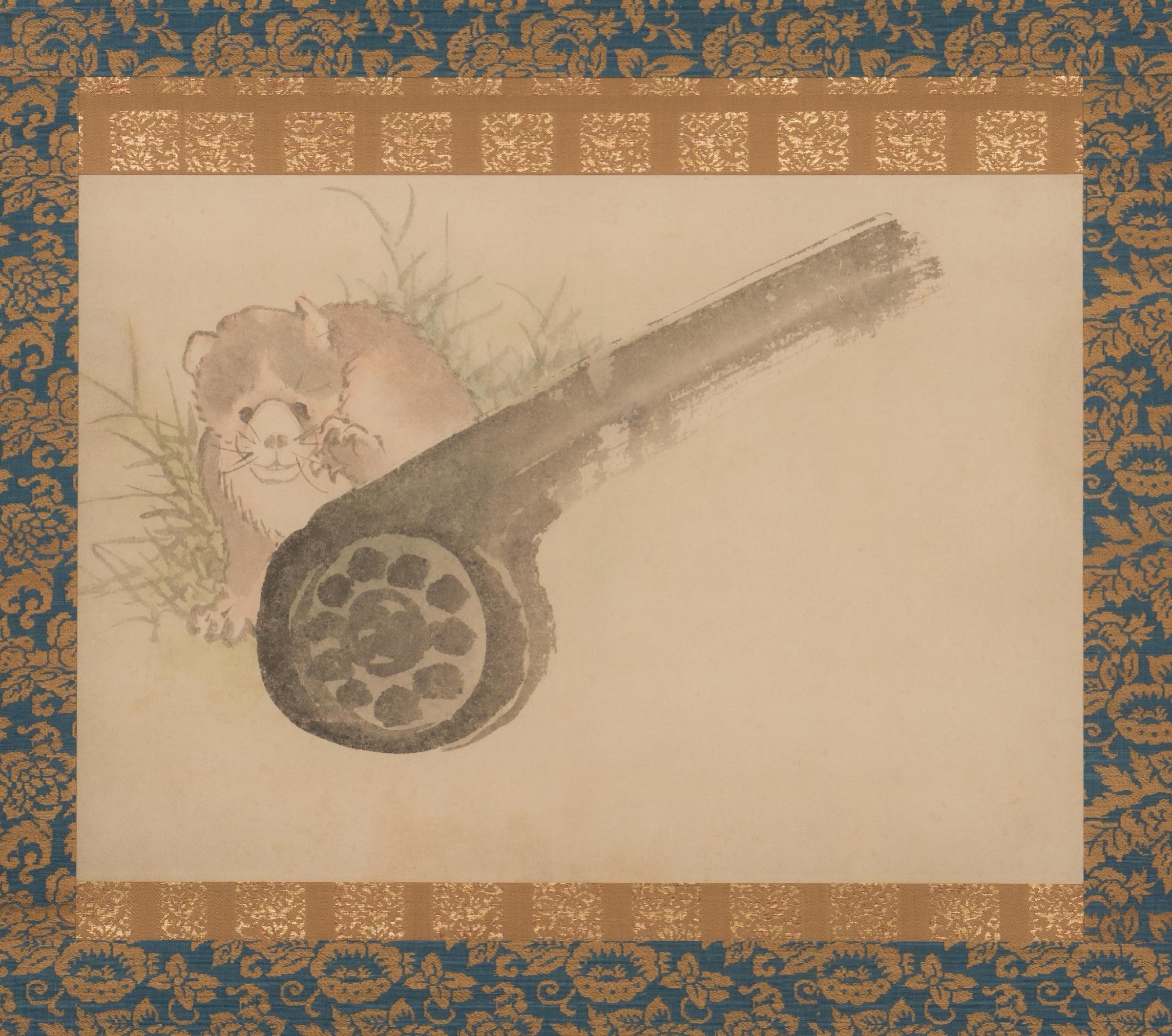
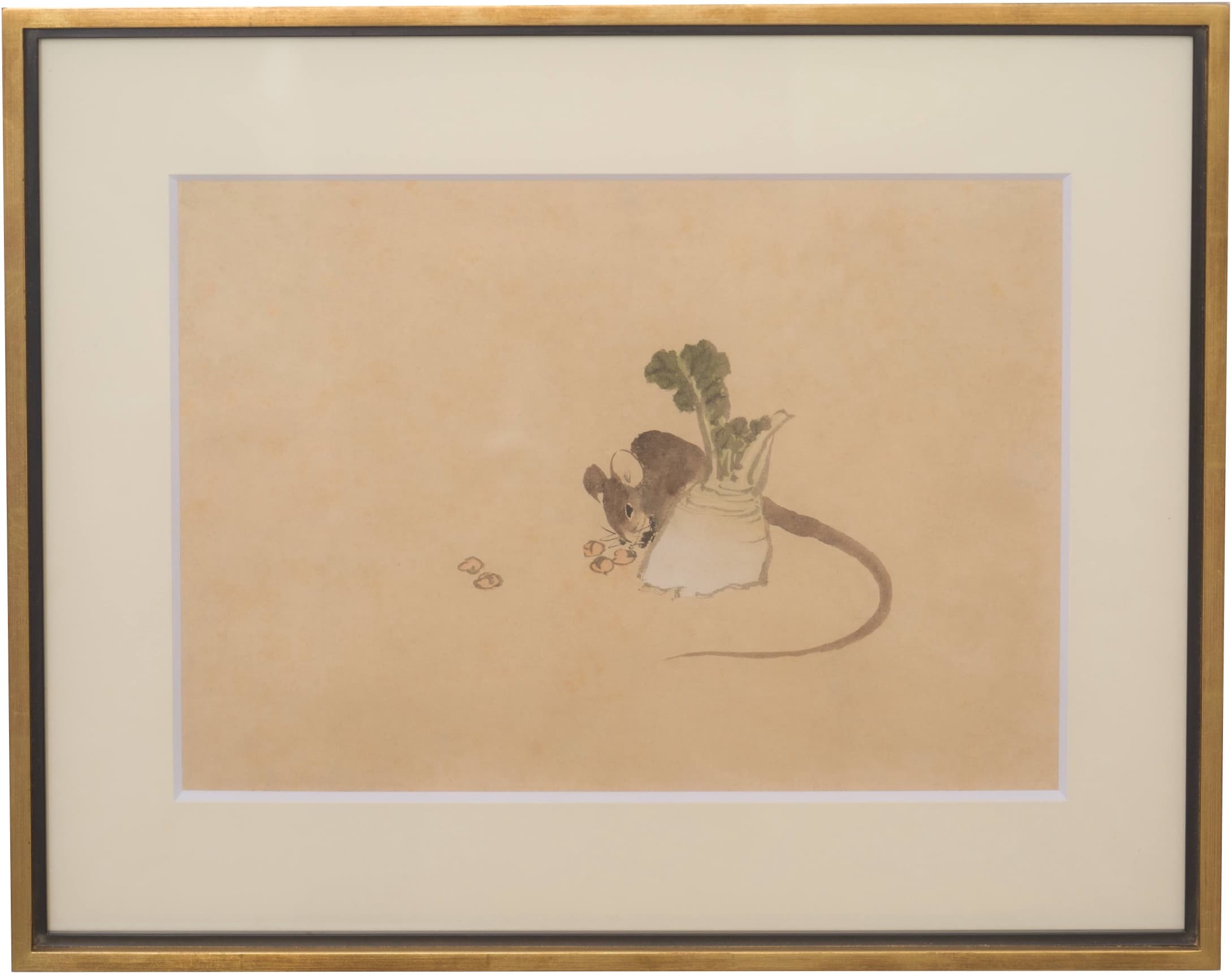
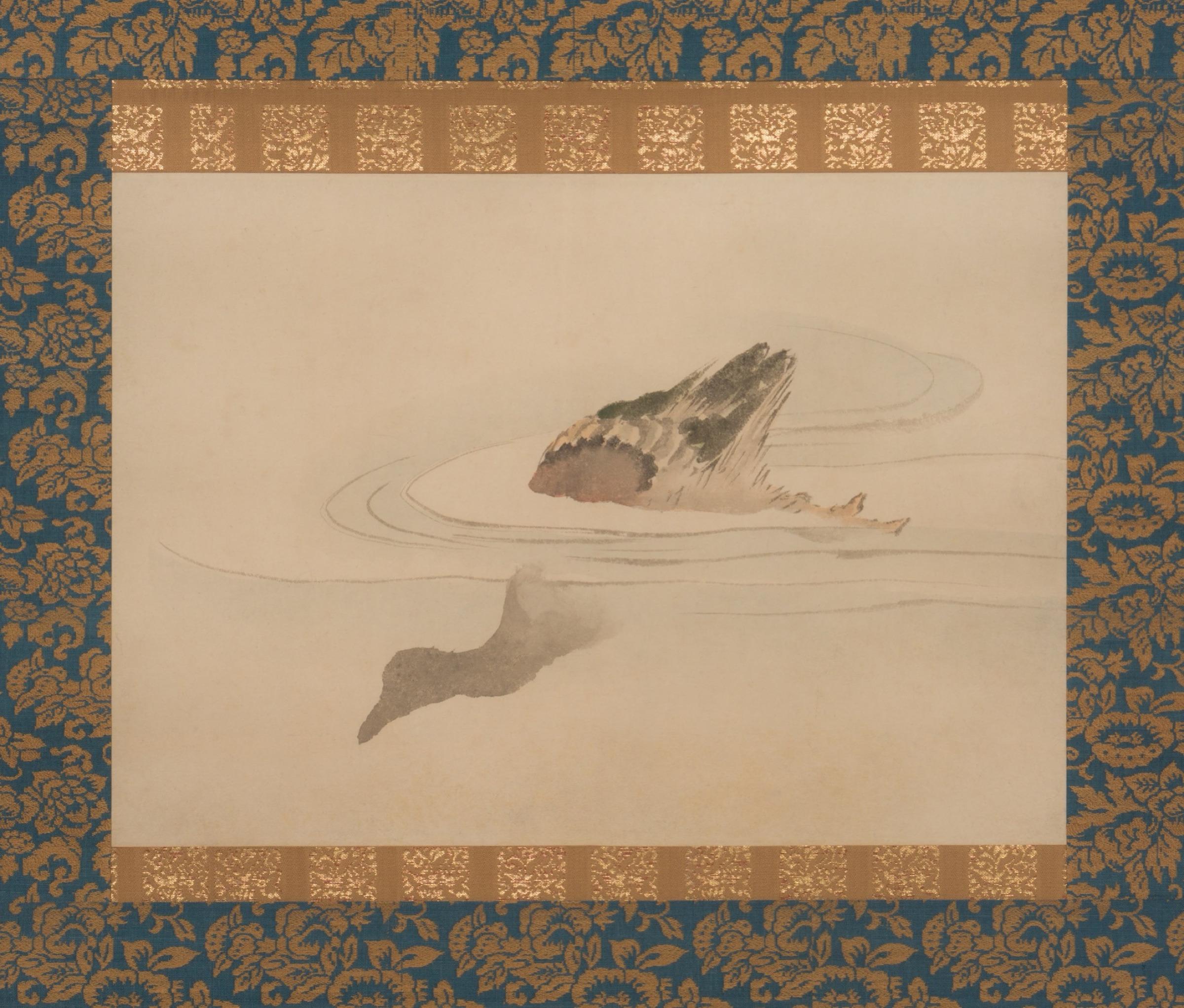
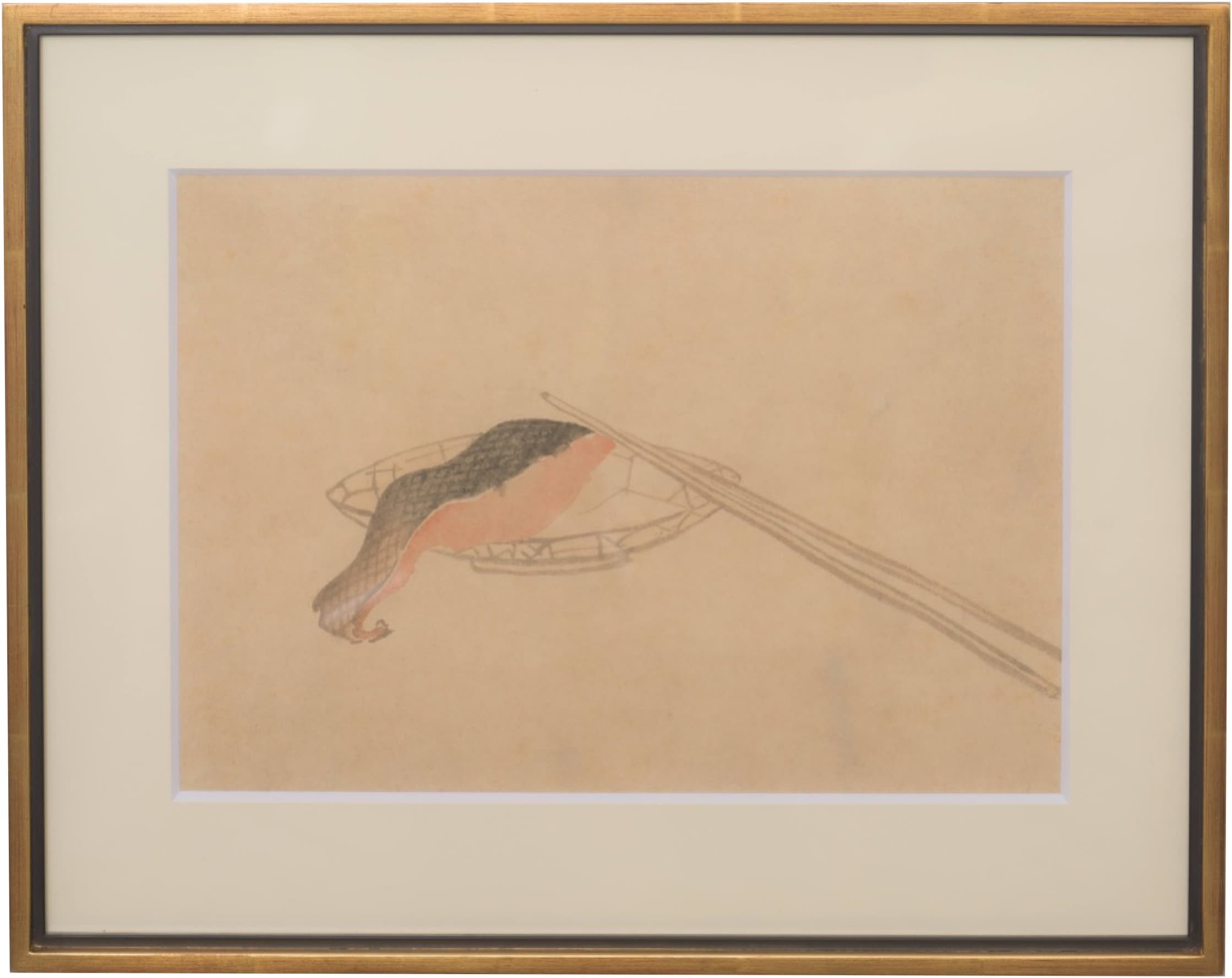
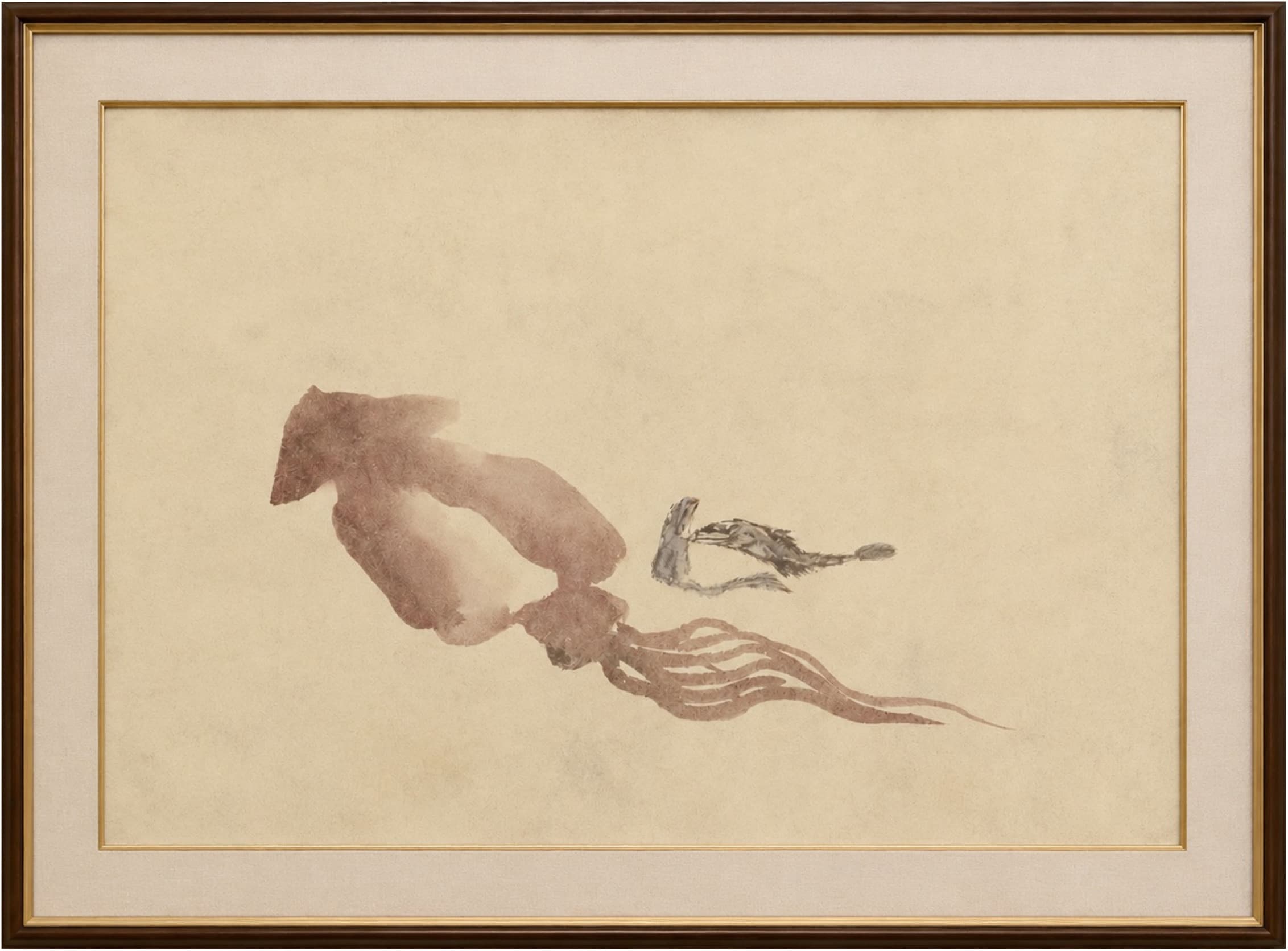
Three are living creatures: a puppy beside a roof tile, a swimming duck, a mouse at a daikon. One is a flower, a bellflower. Three are food: a slice of salmon, dried squid with small fish, and dried bonito. And last, a ghost.
There was no telling who would take to which. So he painted all of them. That spread itself was how he got through the year.
An auspicious picture in a year of hunger
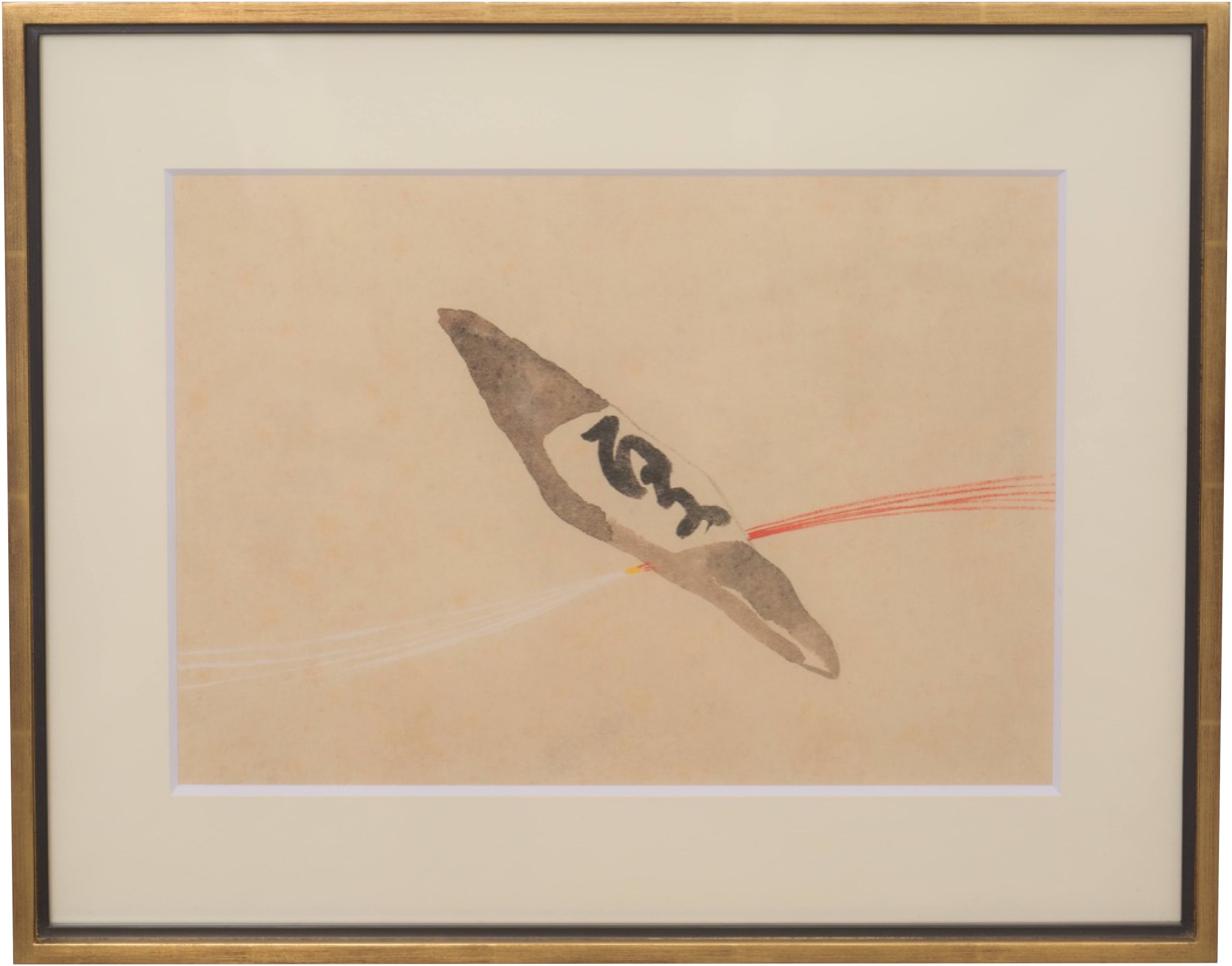
Dried Bonito with Mizuhiki Cords
鰹節と水引図
Ink and colors on Japanese paper 24.1 × 34.0 cm
Dried bonito tied with mizuhiki cords: a mark of gifts and of celebration.
View this workAmong the twelve is a block of dried bonito tied with mizuhiki — the red-and-white cords tied around a formal gift, still knotted on gift envelopes today.
Dried bonito bound with mizuhiki is the shape of a formal present, an auspicious motif that appears only at celebrations. In a year when people were starving in the roads, this is what Hokusai painted.
Not a lament, not a scene of misery. A picture of celebration. Perhaps his own prayers and wishes are folded into it, or his feeling for the lives of those around him. Perhaps he wanted to put something of good omen into the hands of whoever bought it.
The brush did not slacken
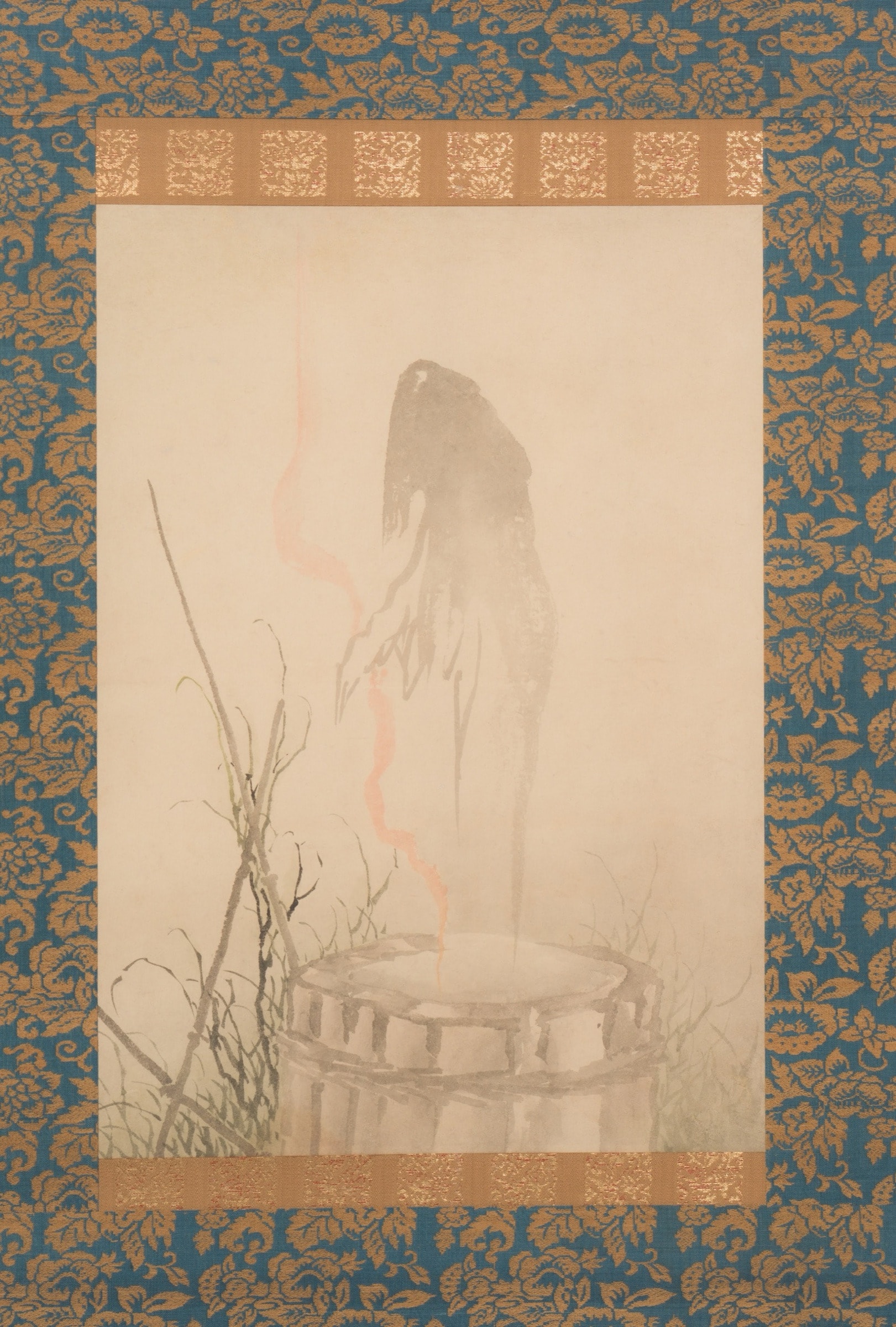
GhostSold
幽霊図
Ink and colors on Japanese paper 24.1 × 34.0 cm
Not fear, but the sense of something appearing and vanishing. Sold.
View this workThere is nothing in Ghost that sets out to frighten. The lines are pared back as far as they will go and the colour is faint. And yet something is there. With only the slightest wavering of the brush, a figure appears and then fades. It is a picture of a presence, not of terror.
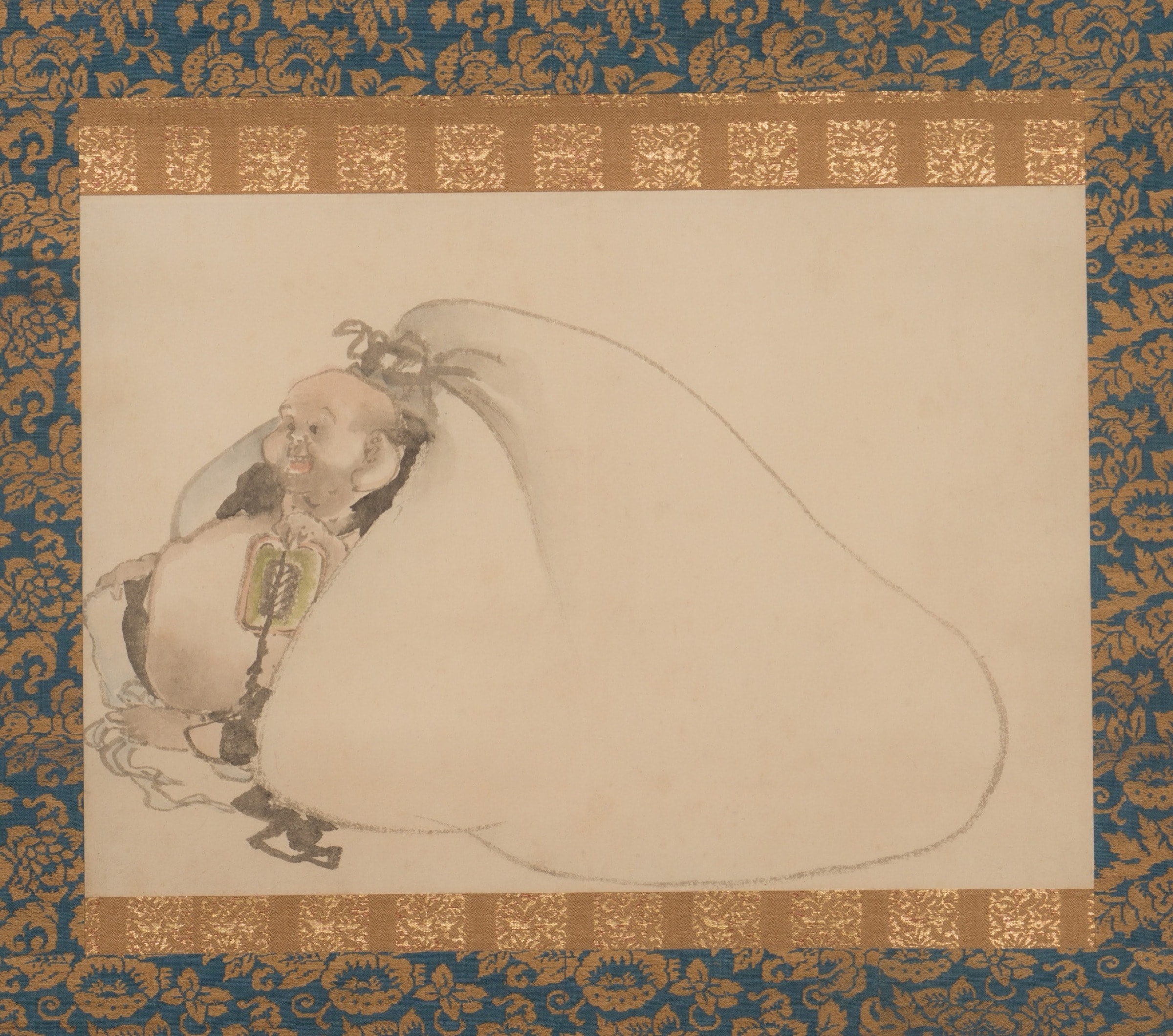
HoteiSold
布袋図
Ink and colors on Japanese paper 24.1 × 34.0 cm
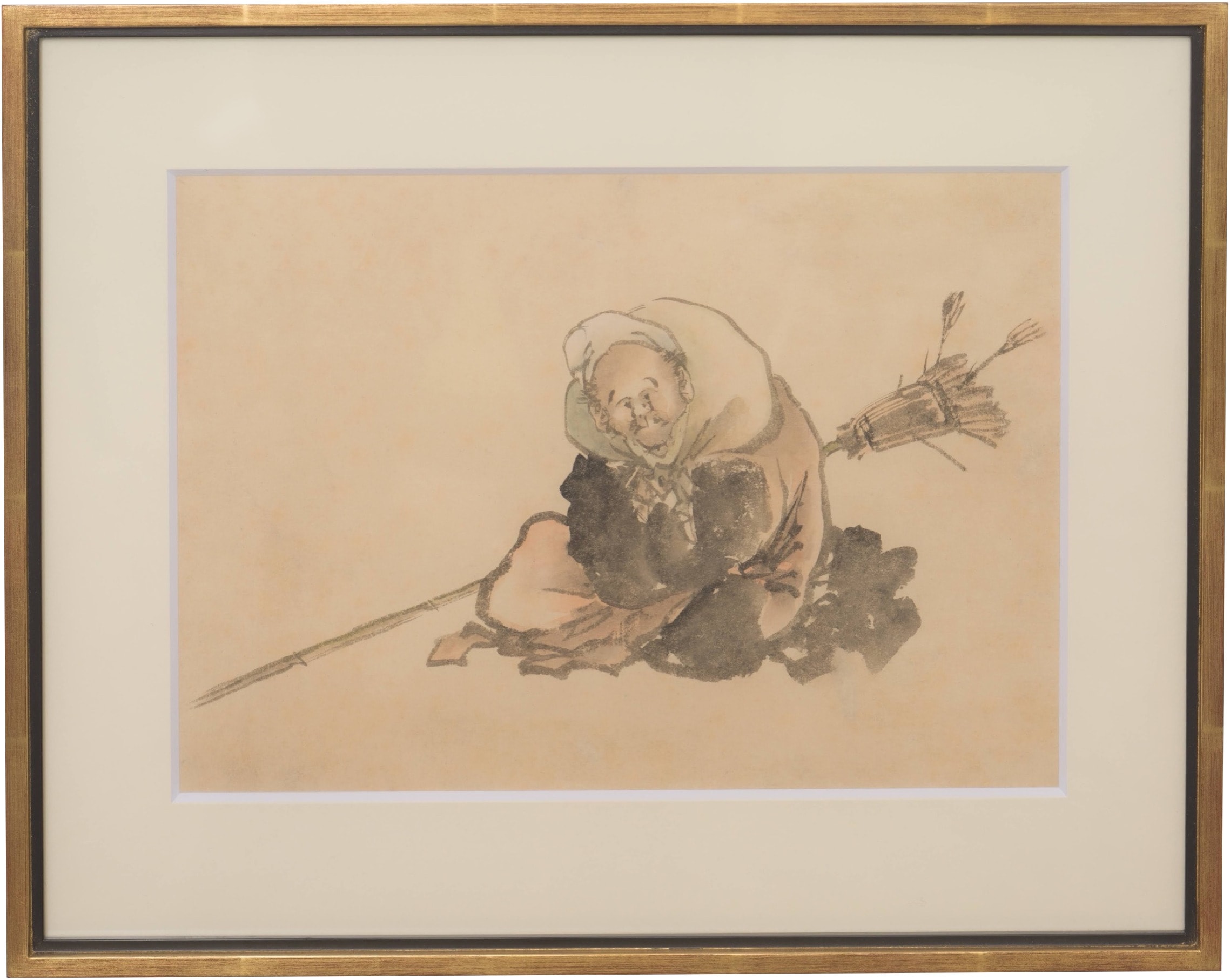
Hotei set across the whole surface — an extremely bold composition. Sold.
View this workBeside it is Hotei, its opposite in every way: the figure spreads across the entire sheet. These are not lines that trace a shape. The brush runs, and the running is the form. The hand of a man enjoying the life of his own line is still there on the paper.
He painted them to eat. No one would have known if he had eased off. And yet these two stand side by side in the same album, from the same year.
The twelve survived
The album was later taken apart, and the sheets are now mounted one by one as scrolls or in frames. Twelve pieces of paper, painted for that day’s food, were not scattered: they have come down together across nearly a hundred and ninety years.
The work of the painter’s hardest year is now in front of us. Ghost and Hotei have been sold. The remaining ten may be seen in person, and we are glad to discuss their purchase.
The other nine of the twelve
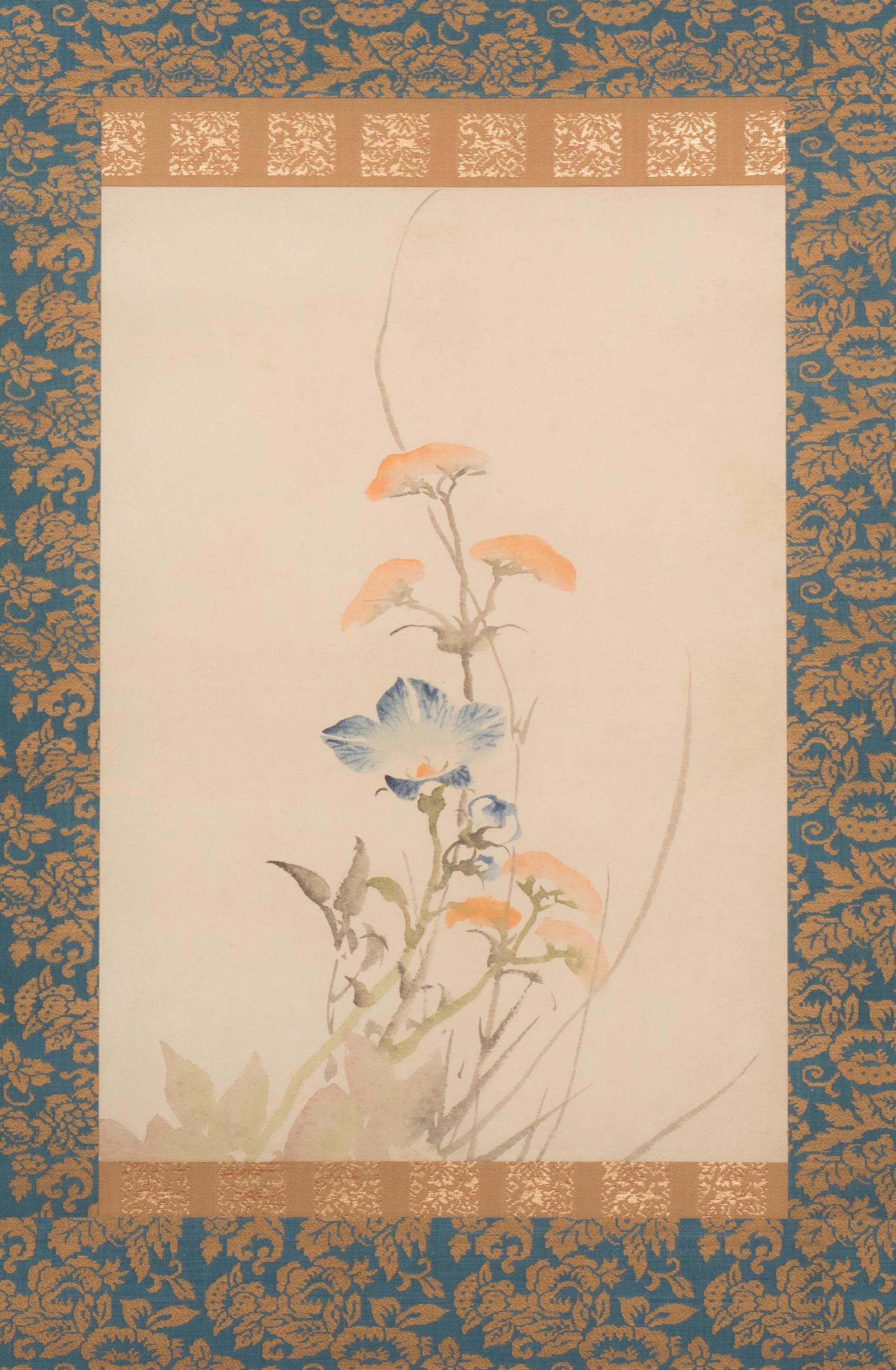
Besides the three seen above, nine remain. People, animals, a flower, food — every subject the painter, at seventy-seven, could think of to carry himself through that year. Together with the three above, these are all twelve.
Supervising editor
Yoshihisa EndoJapan Art Academy Representative Director
Born in Nishi-Azabu, Tokyo, in 1940. After graduating in French literature from Chuo University and a period in business, he founded a video production company. Negotiating directly with the Louvre, the Prado, the Hermitage and other museums, he filmed their collections in high definition for series such as The Museums of the World (1991), and published a multi-volume museum encyclopedia with twenty professors led by the art historian Seiro Maekawa.
He has produced or supervised more than a thousand television programmes on art (The World's Masterpieces on BS Asahi and Painter × Painter on BS Nippon TV among them), and his books include Letters from Vermeer and Lautrec and Mucha (Random House Kodansha) and a study of the Hokusai Manga (Kawade Shobo Shinsha). He is representative director of the Japan Art Academy (founded 2010) and a director of the International Hokusai Society (founded 2019). As a filmmaker he works under the name Hisashi Fuji.
The Japan Art Academy (founded 2010), which plans and supervises this series, works in art film and publishing, and established the International Hokusai Society in 2019. Based in Nihonbashi Odenma-cho, Tokyo, it carries out research on Hokusai's hand-painted works and compiles catalogues of them, and supervises the colour of the reissued Thirty-six Views of Mount Fuji printed by Takahashi Kobo. In 2026 it published Exploring the Appeal of Hokusai's Original Paintings, a catalogue of hand-painted works that includes pieces never shown before, edited and written by its executive director, Hiromi Yasui.
Credits
- Planning and materials
- International Hokusai Society, Japan Art Academy
- Supervision
- Yoshihisa Endo, Representative Director, Japan Art Academy