Article
Buying a Hokusai painted by his own hand
Hokusai is known for prints. He also painted directly with the brush — one sheet, one hand, no block between. The gallery currently holds twelve album leaves, five hanging-scroll works in six scrolls, three fan paintings — twenty paintings in all, one of them sold — and three Thirty-six Views reprinted and mounted as scrolls.
Supervised by Yoshihisa Endo, Representative Director, Japan Art Academy
The printed Hokusai and the painted Hokusai
What carried the name of Katsushika Hokusai (1760–1849) around the world was the print: the Thirty-six Views of Mount Fuji above all. A print is a collaboration — the painter's drawing passes through the hands of the block-cutter and the printer, and some two hundred impressions of the first printing go out into the world. A painting is different: one sheet only, touched by Hokusai's own brush. The speed of the line, the depth of the ink, even the hesitation where the brush was changed, are all still there.
The gallery holds twenty such paintings, one of which is sold. They fall into three groups: twelve album leaves said to have been painted around 1836, five hanging-scroll works in six scrolls spanning his early period to his old age, and three fan paintings made between his late seventies and the age of eighty-three. To these we add three of the Thirty-six Views, reprinted under the colour supervision of the International Hokusai Society and mounted as hanging scrolls — twenty-three items that can be seen and acquired today.
What follows is a plate book in the same sequence as the booklet we hand out at the gallery. Each plate leads to that work's own page. All dimensions and materials are as recorded in the documentation we received with the works.
I
Twelve Album Leaves
Hokusai at seventy-seven
Twelve leaves said to date from around 1836, when the painter was seventy-seven. They were kept together as one album.
A title slip pasted to the album's cover records its origin: in the great famine of 1836 many lay fallen in the roads; at that time the aged Hokusai, then seventy-seven, conceived this album and by it barely kept himself fed. The slip speaks of Hokusai in the third person and ends with a phrase meaning “so it is said.” It is not in his own words; it was written later by someone into whose hands the album came. Who wrote it, and when, is not known. What is known is that these twelve leaves have come down together as one album, and that this account has come down with them.
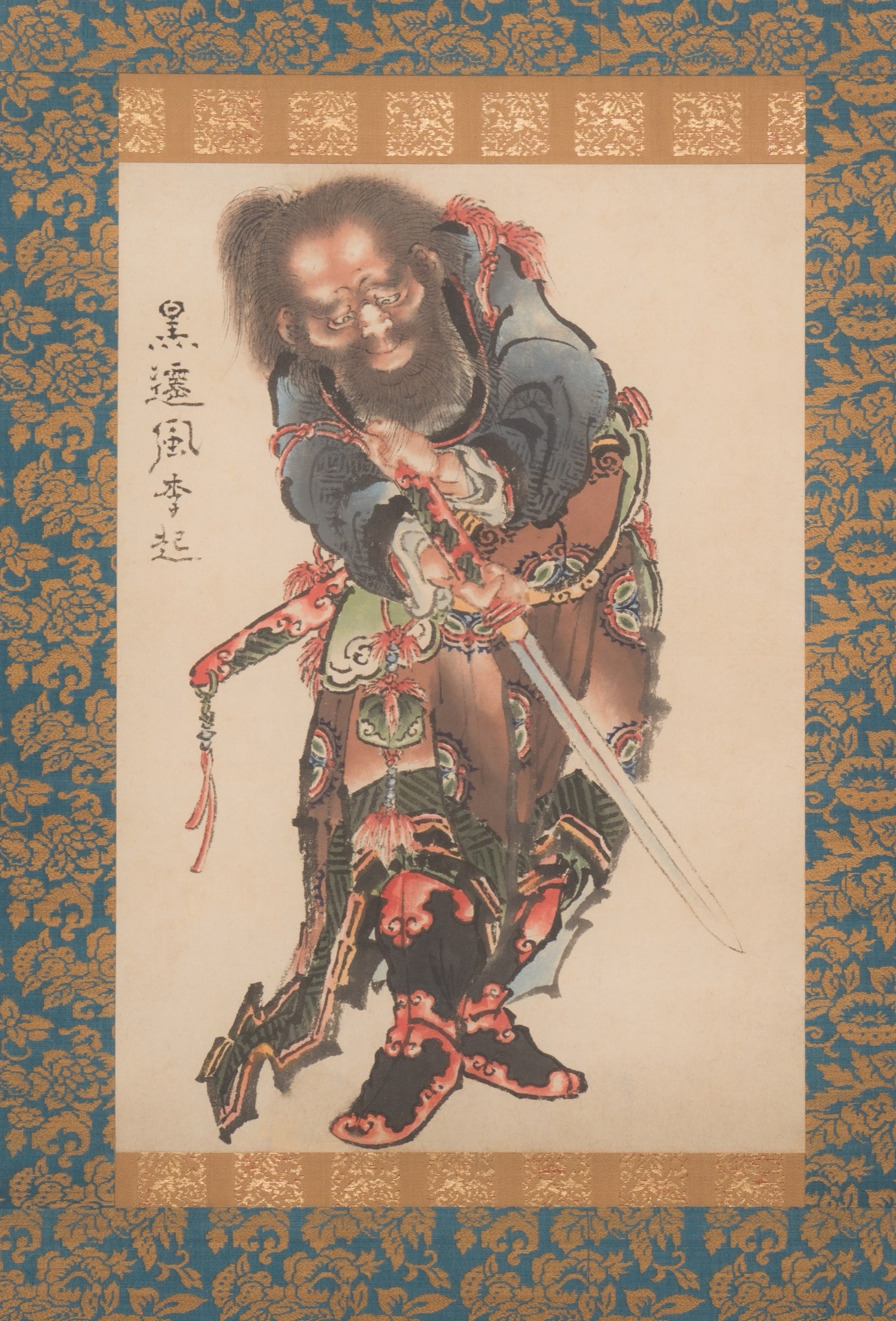
Li Kui, the Black Whirlwind
黒遷風李起図
Ink and colors on Japanese paper 24.1 × 34.0 cm
The first leaf: a hero of the Chinese classic The Water Margin brought into the small compass of an album sheet.
View this work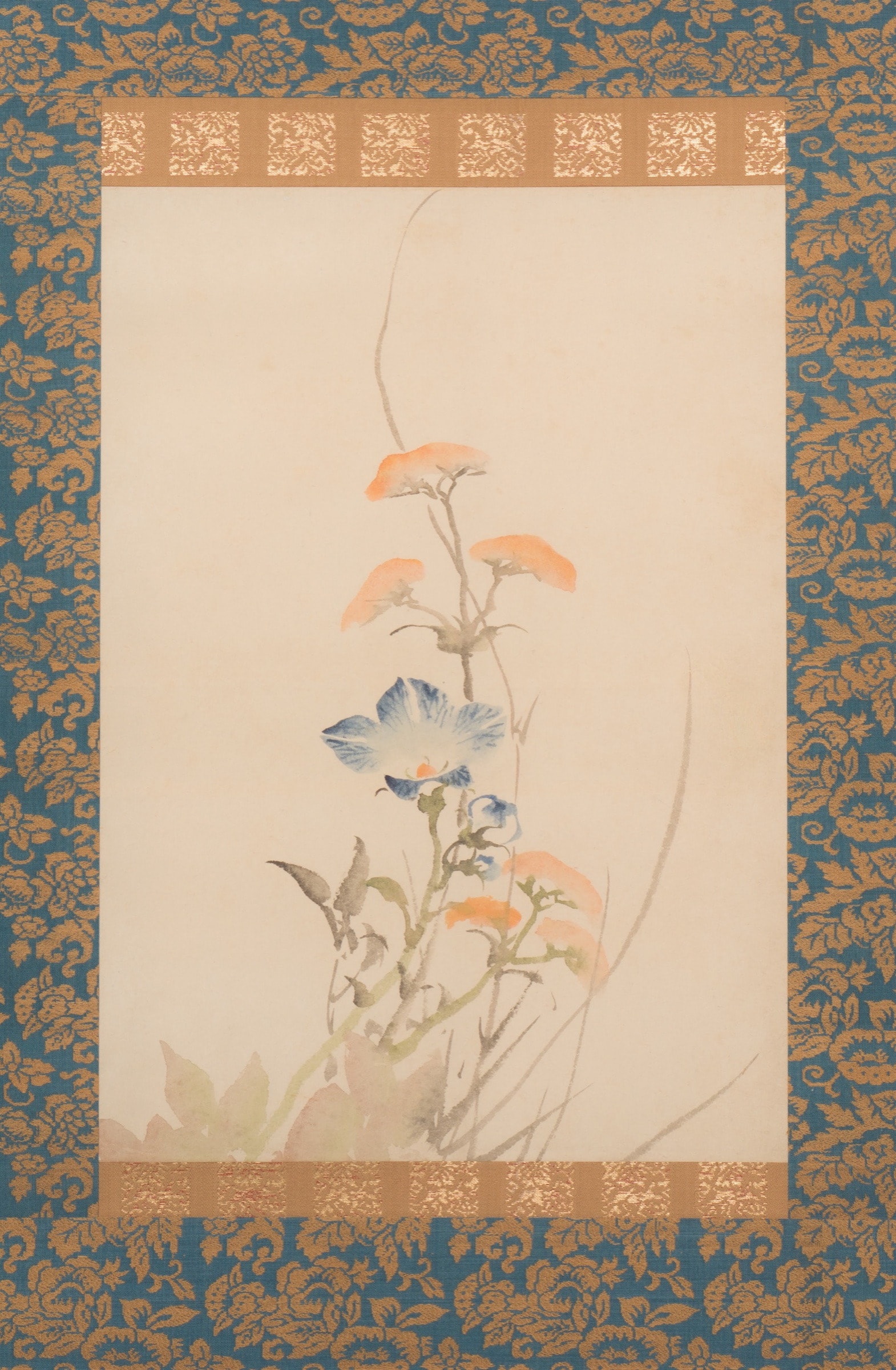
Bellflowers
桔梗図
Ink and colors on Japanese paper 24.1 × 34.0 cm
Wildflowers in the fewest colours; the line alone carries the life of the plant.
View this work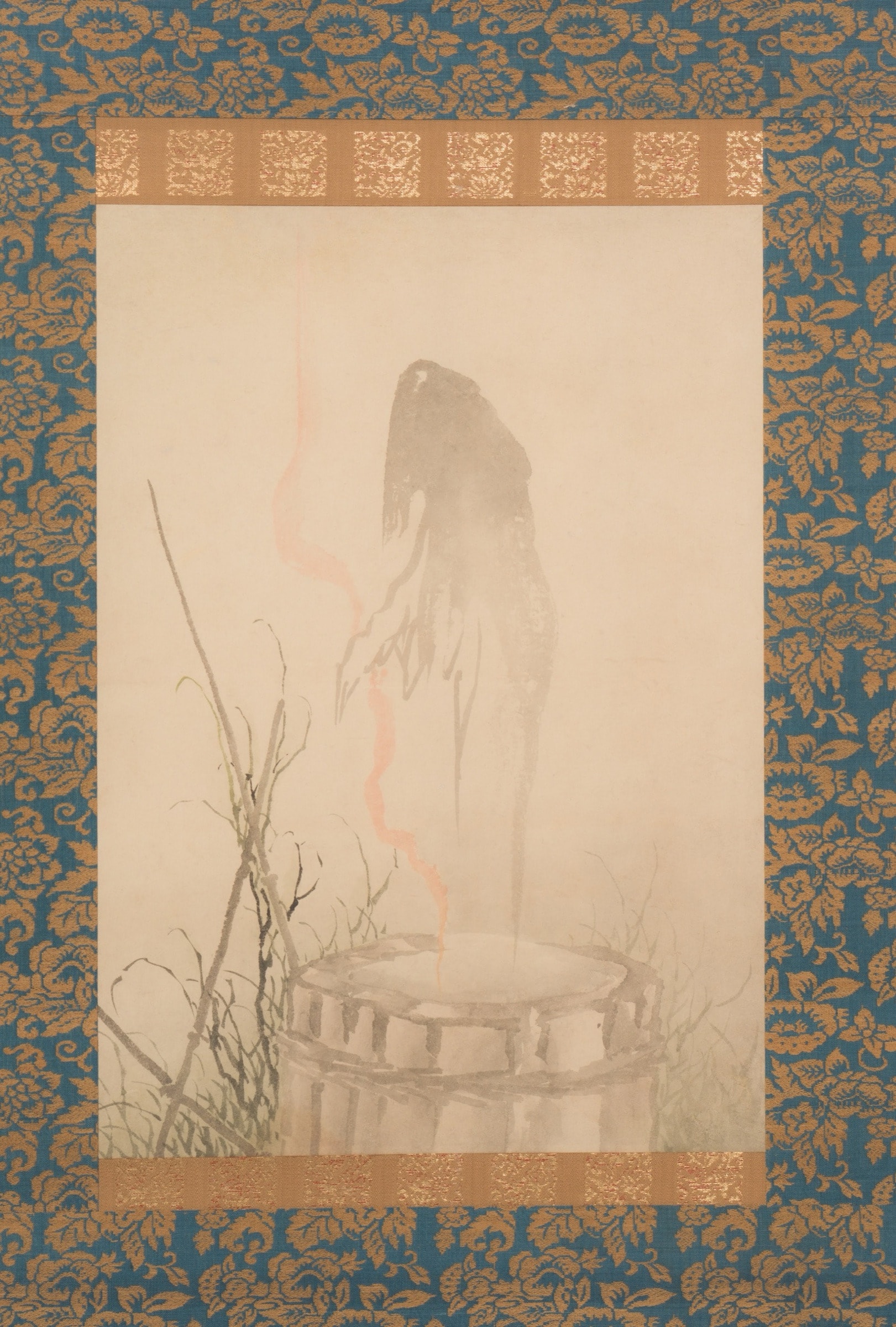
Ghost
幽霊図
Ink and colors on Japanese paper 24.1 × 34.0 cm
Hokusai drew many ghosts. This is his most abbreviated line.
View this work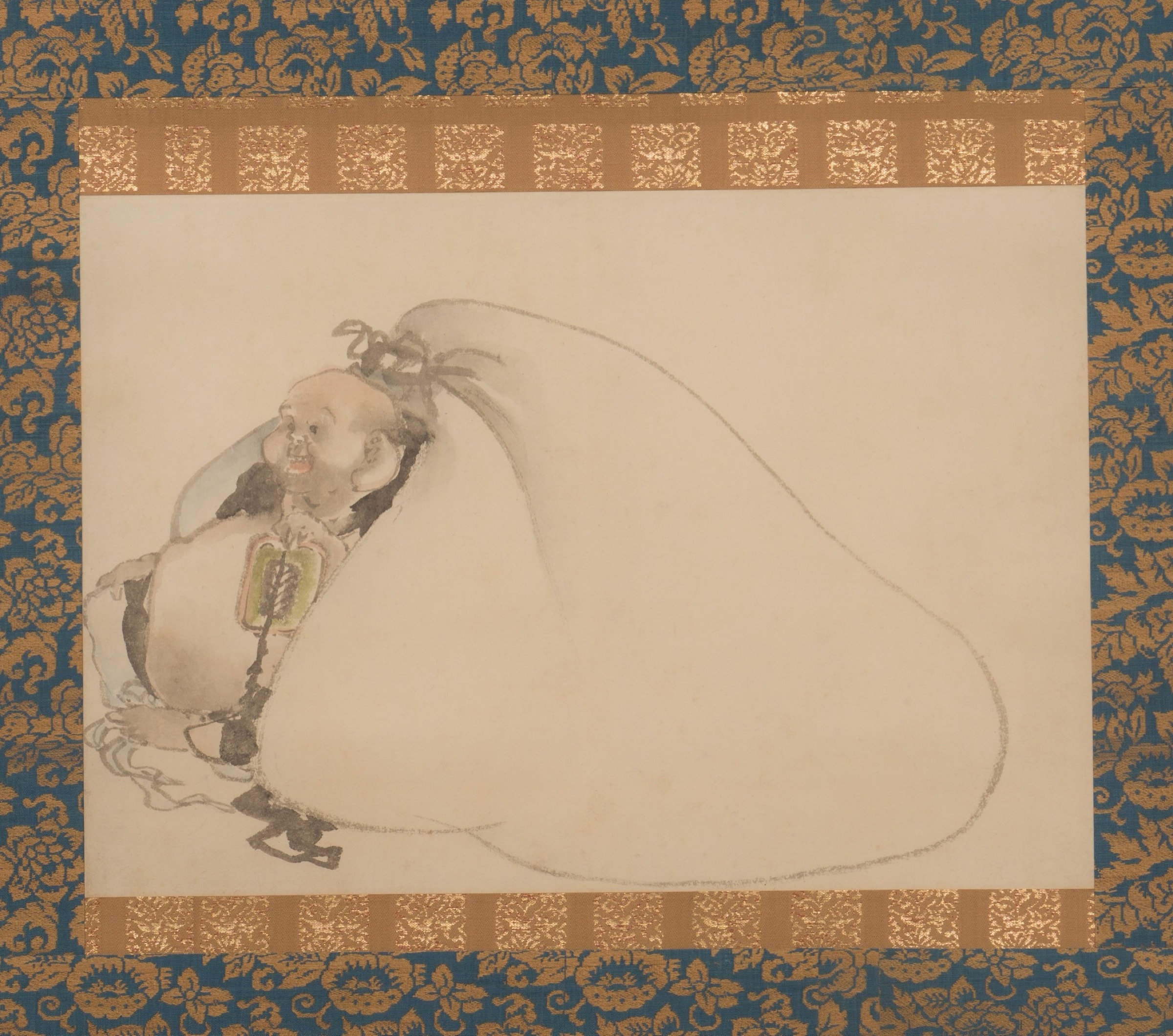
Hotei
布袋図
Ink and colors on Japanese paper 24.1 × 34.0 cm
The momentum of the brush spreading to the edges — the largest movement in the album.
View this work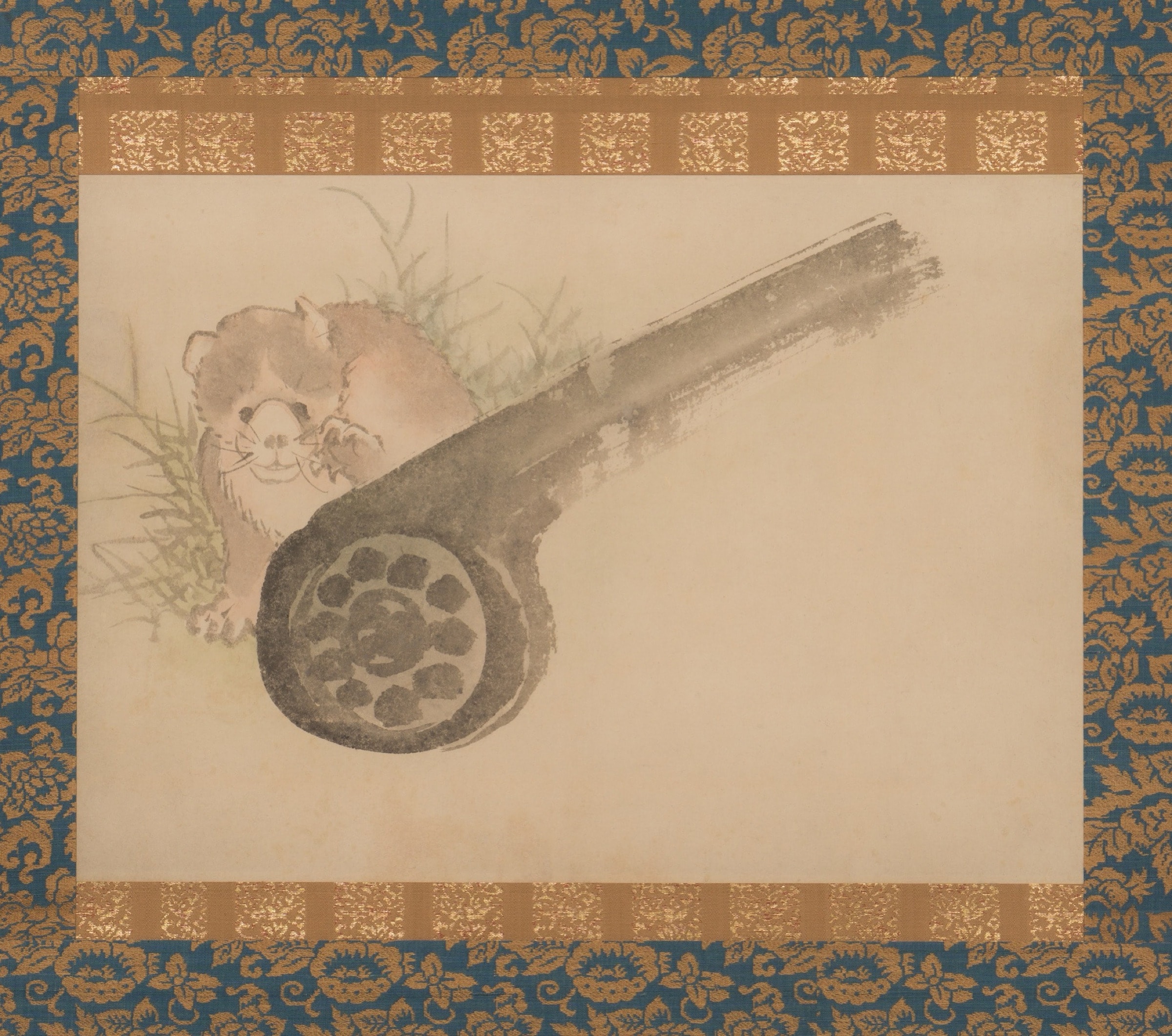
Puppy and Roof Tile
犬と瓦図
Ink and colors on Japanese paper 24.1 × 34.0 cm
A roof tile and a puppy: a still object and a living creature in one sheet.
View this work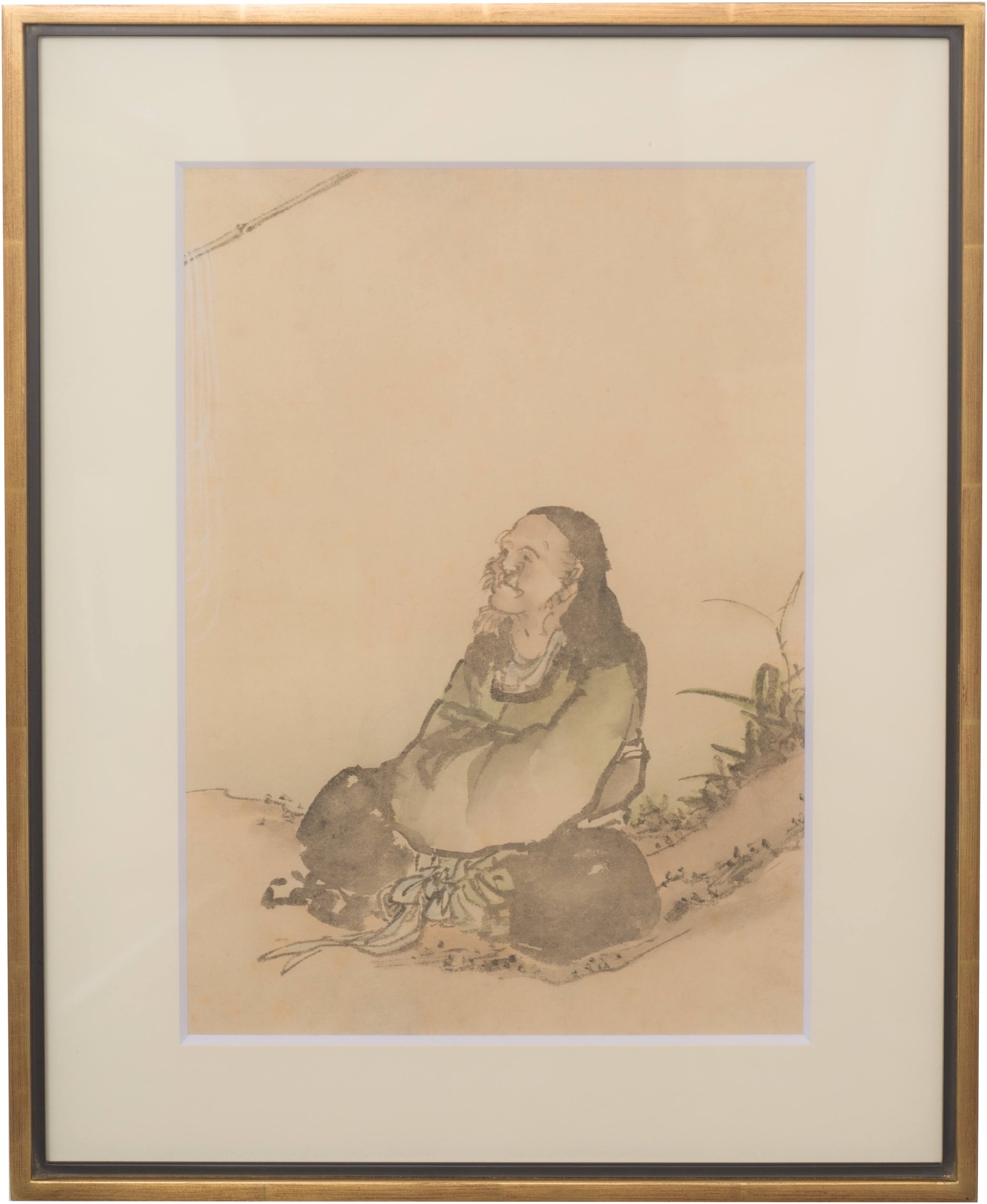
Confucius
孔子図
Ink and colors on Japanese paper 34.0 × 24.1 cm
The only leaf in portrait format. It reflects the value Edo placed on reverence for others.
View this work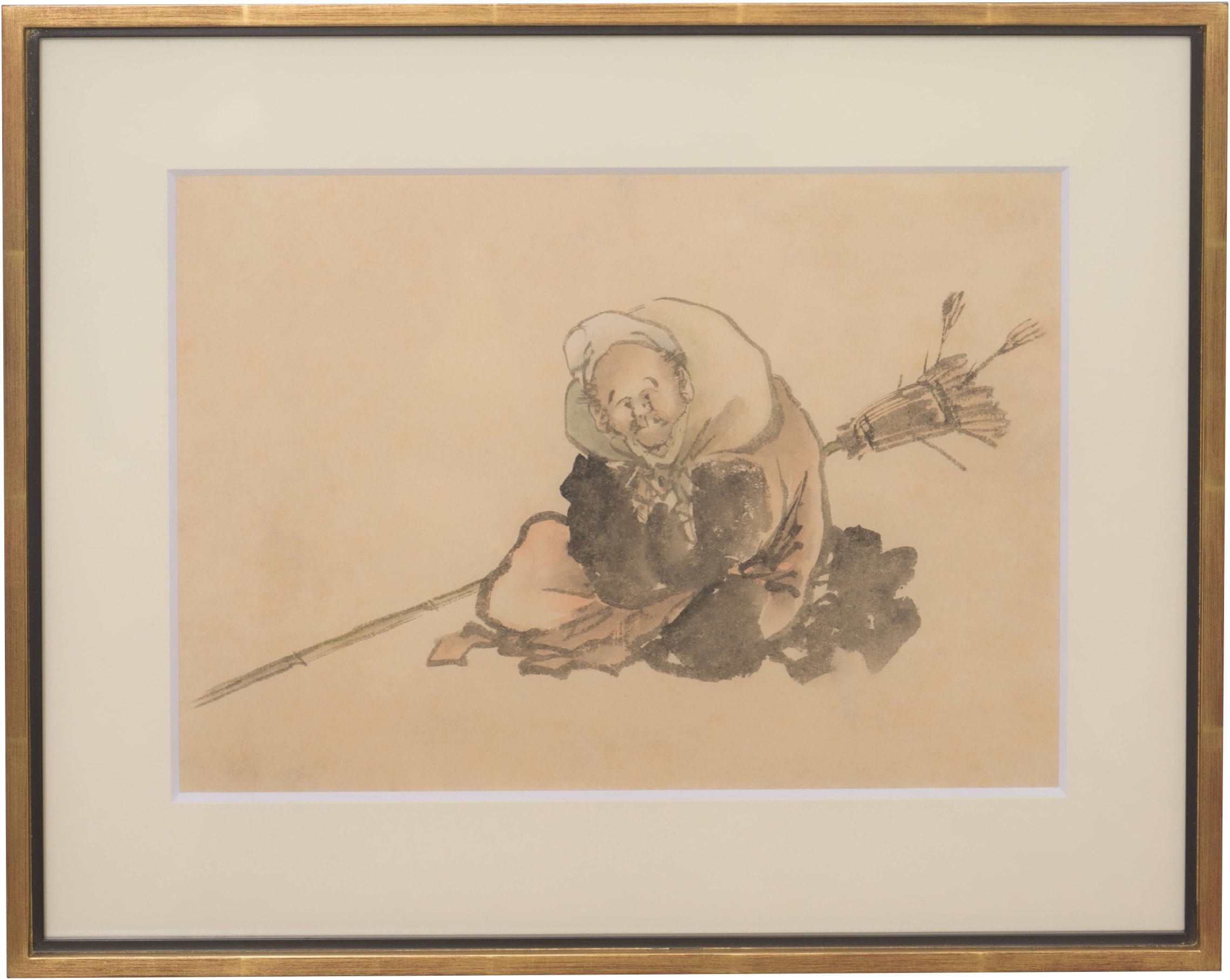
Tea-Whisk Peddler
茶筅売図
Ink and colors on Japanese paper 24.1 × 34.0 cm
Men who sold tea whisks at the year's end — a custom Hokusai returned to.
View this work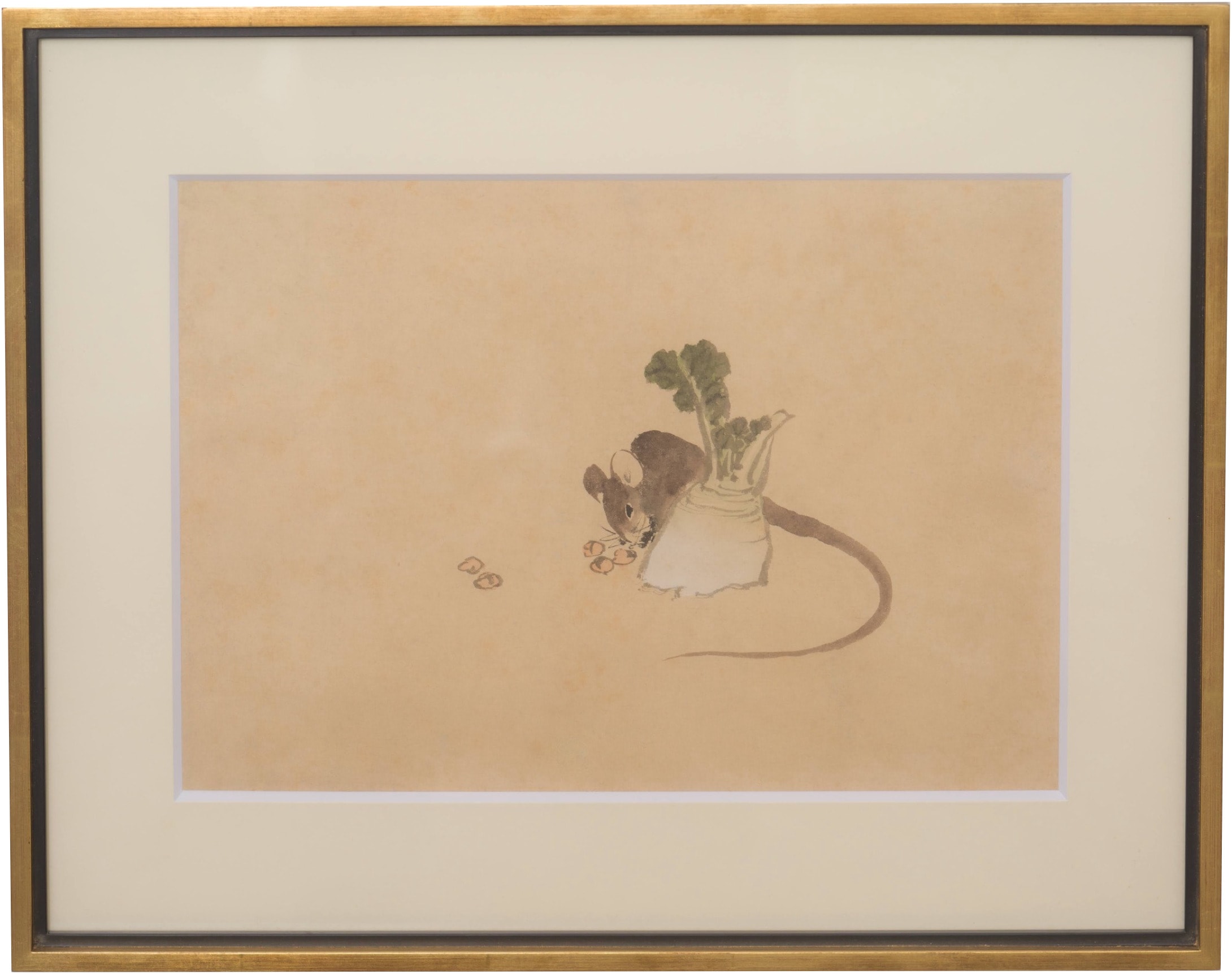
Rat and Daikon Radish
鼠と大根図
Ink and colors on Japanese paper 24.1 × 34.0 cm
A pairing drawn from the old tale of the deity Okuninushi and a rat, auspicious by implication.
View this work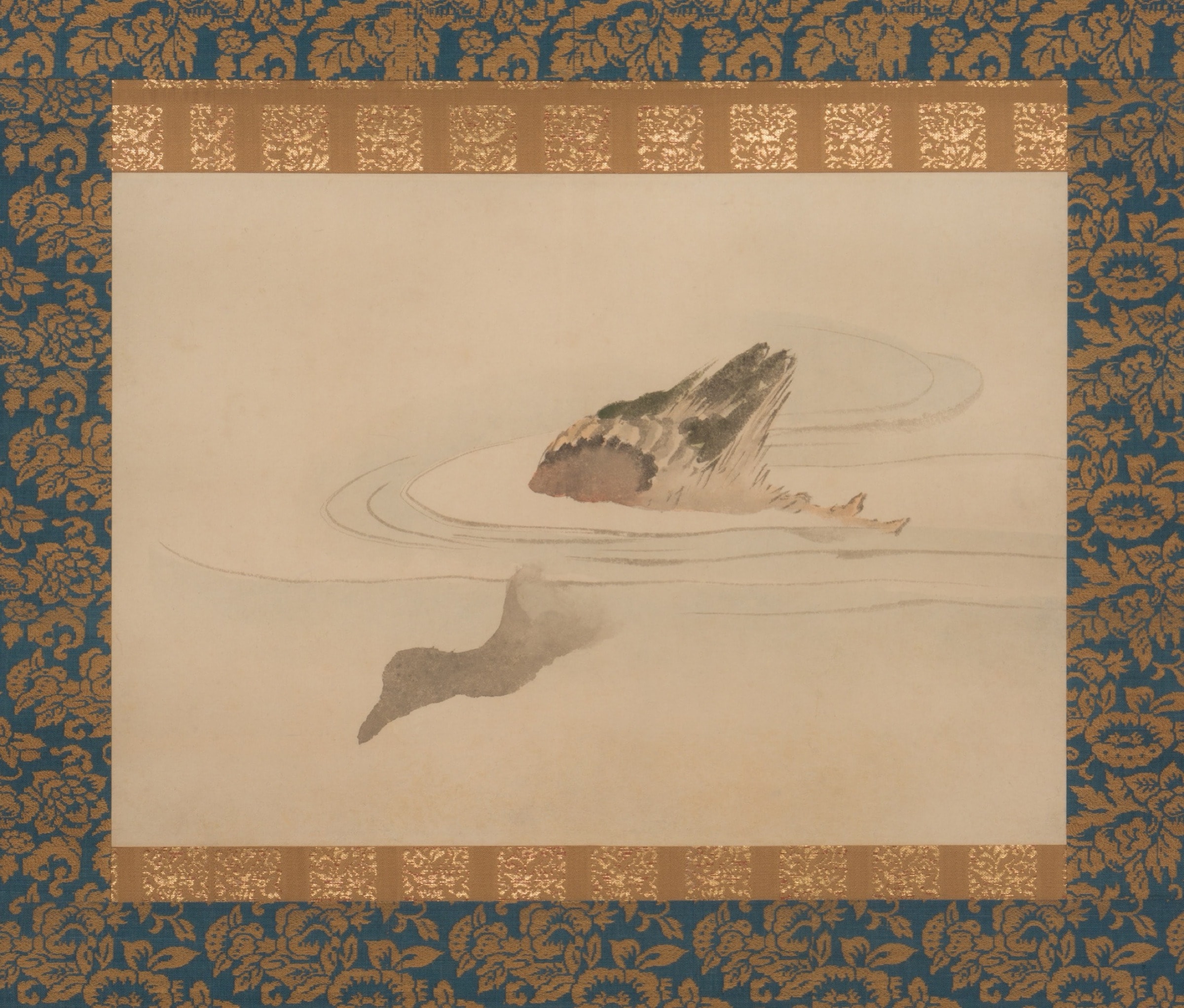
Swimming Duck
鴨遊泳図
Ink and colors on Japanese paper 24.1 × 34.0 cm
Hokusai of water: the abbreviated brush carries even the speed of the swimming bird.
View this work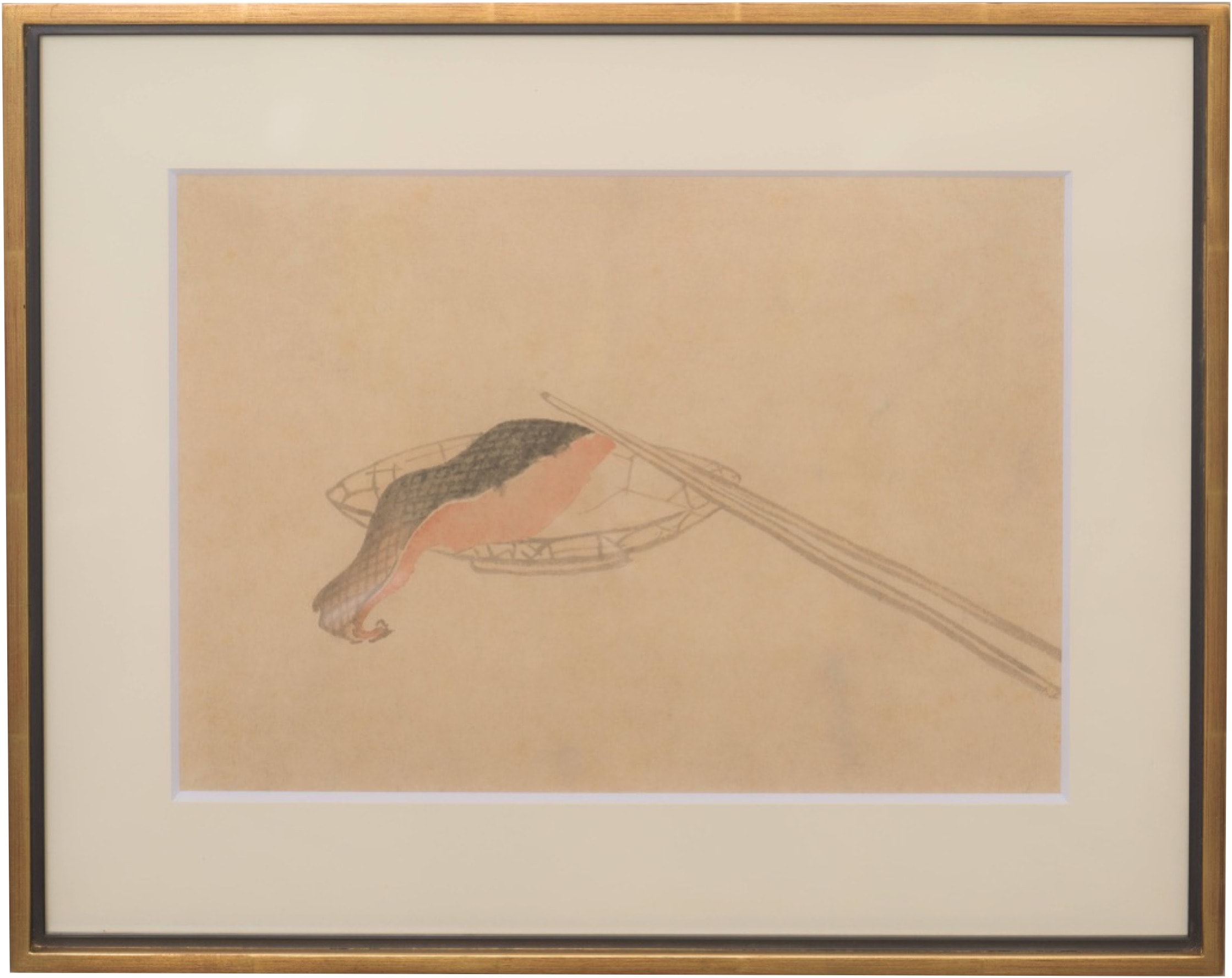
Slice of Salmon
鮭の切身図
Ink and colors on Japanese paper 24.1 × 34.0 cm
Salmon, precious in Edo — a familiar food that carried special meaning.
View this work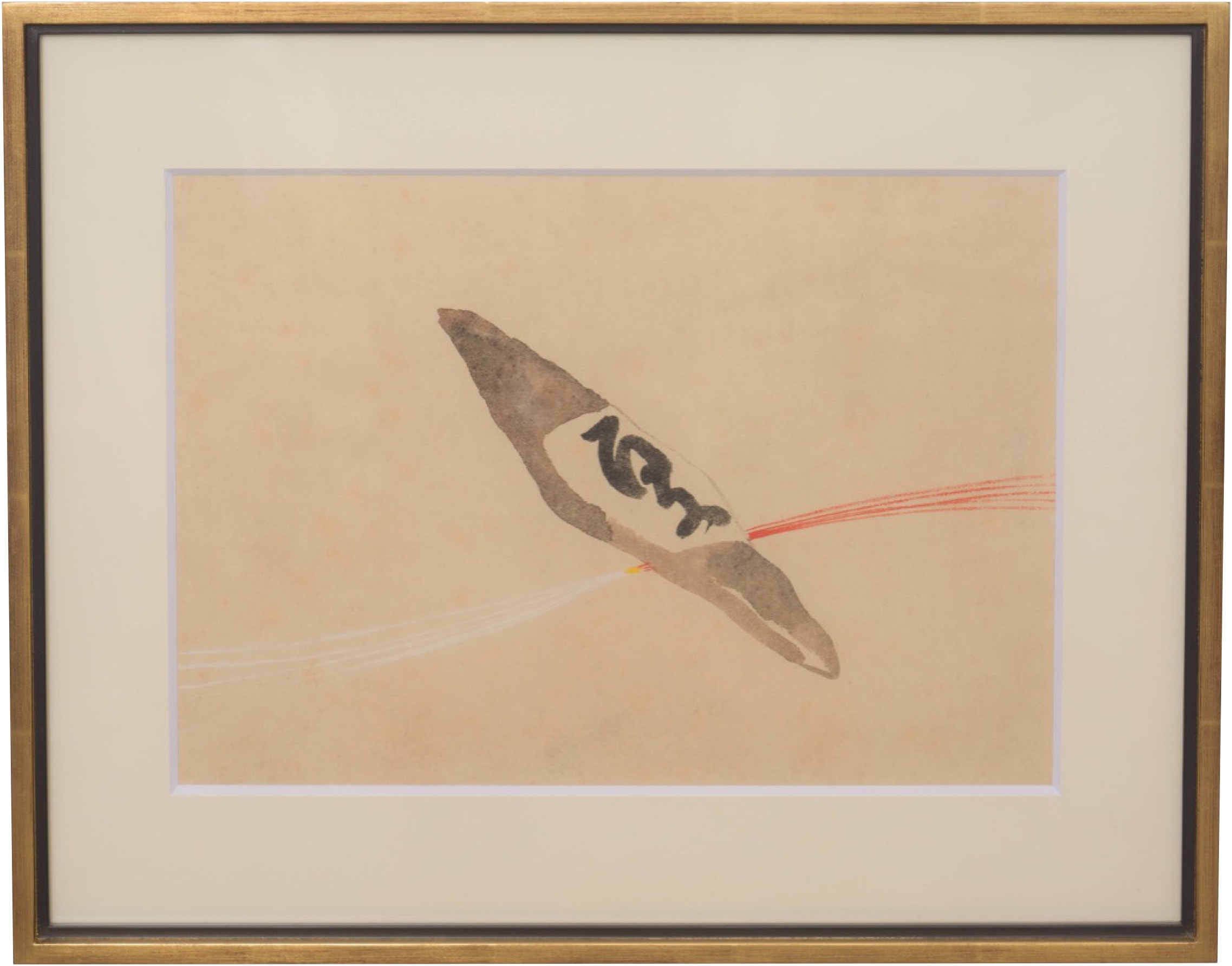
Dried Bonito with Mizuhiki Cords
鰹節と水引図
Ink and colors on Japanese paper 24.1 × 34.0 cm
A festive motif, painted in a year of famine.
View this work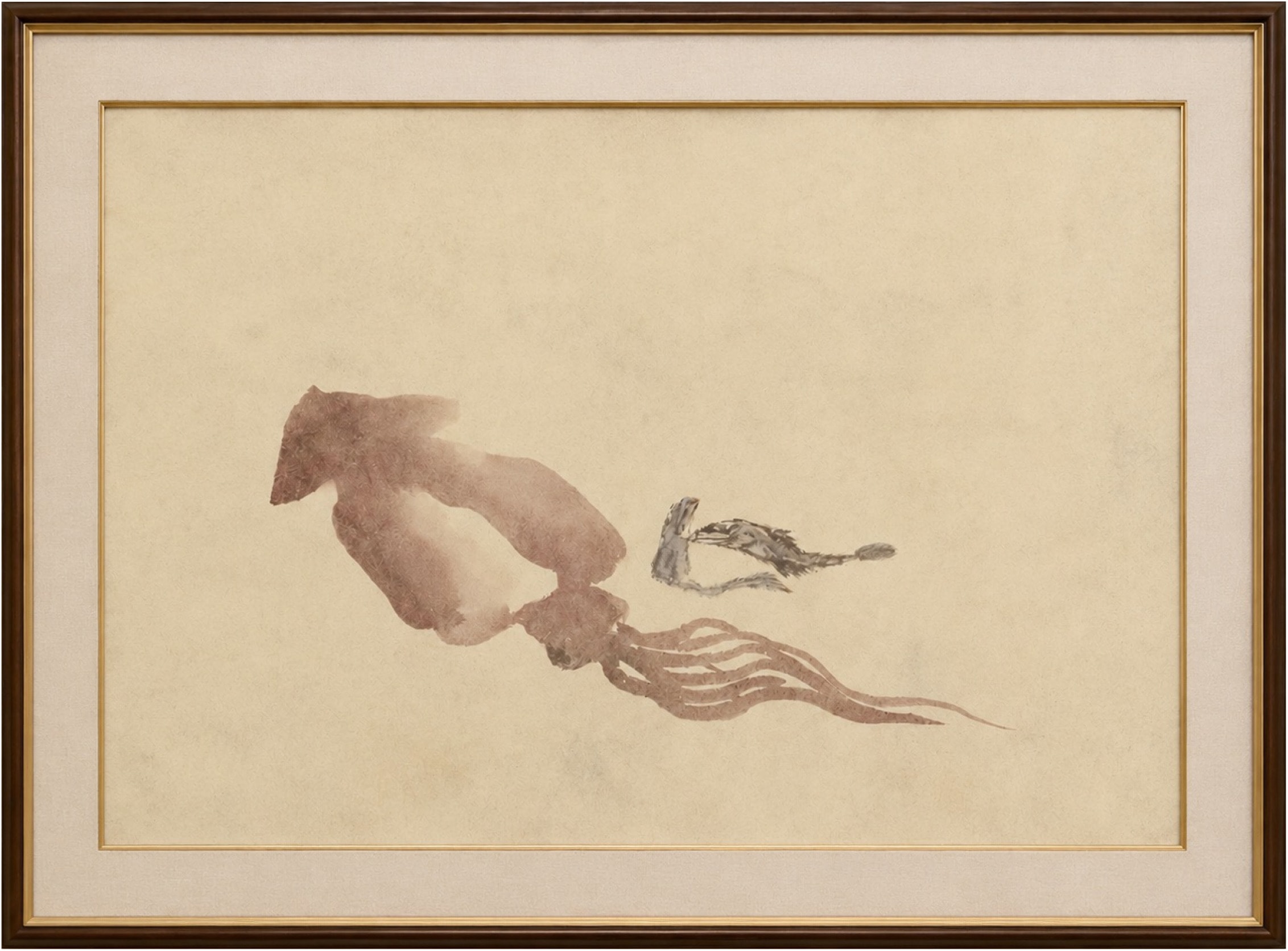
Dried Squid and Small Fish
するめと雑魚図
Ink and colors on Japanese paper 24.1 × 34.0 cm
Preserved seafoods, which bound people together through gifts and celebrations.
View this workII
Hanging Scrolls
From the Sori years to the age of eighty
From the early period, when he signed himself Sori, to a scroll signed at the age of eighty. Five works in six scrolls.
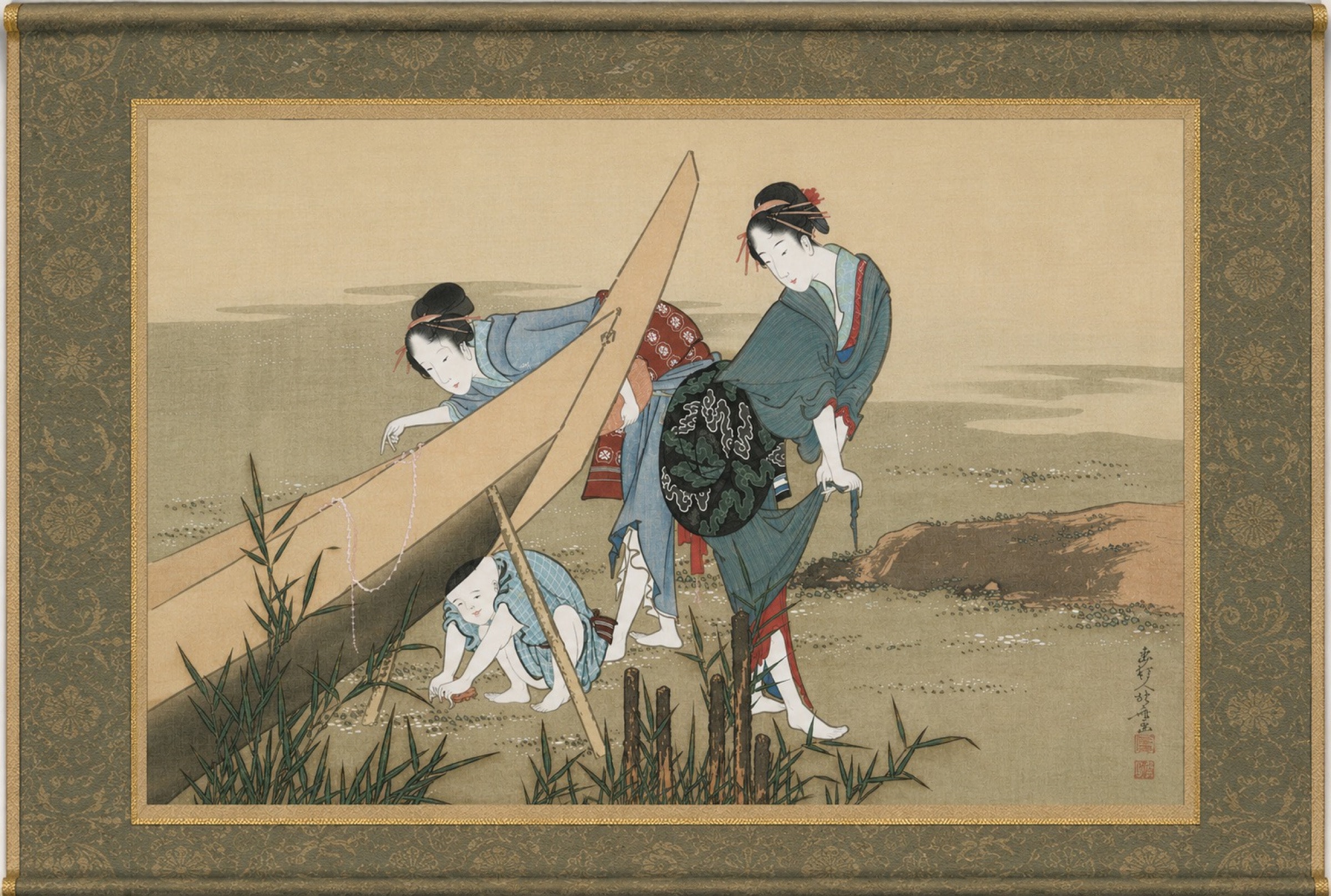
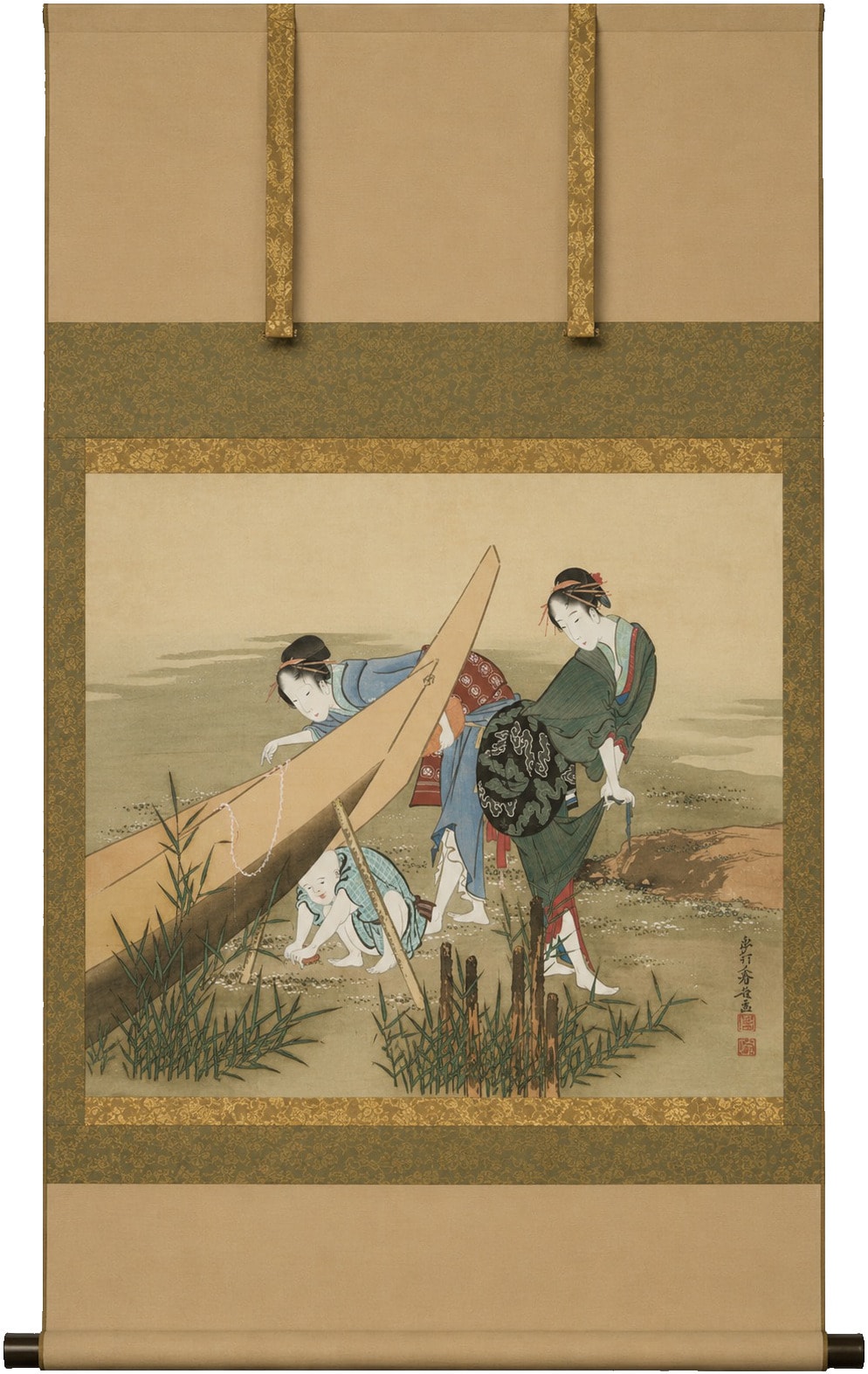
Gathering Shellfish at Low Tide
潮干狩り図
32.5 × 47.9 cm
The manner of his early period; the boldness of his later compositions is already in bud.
View this work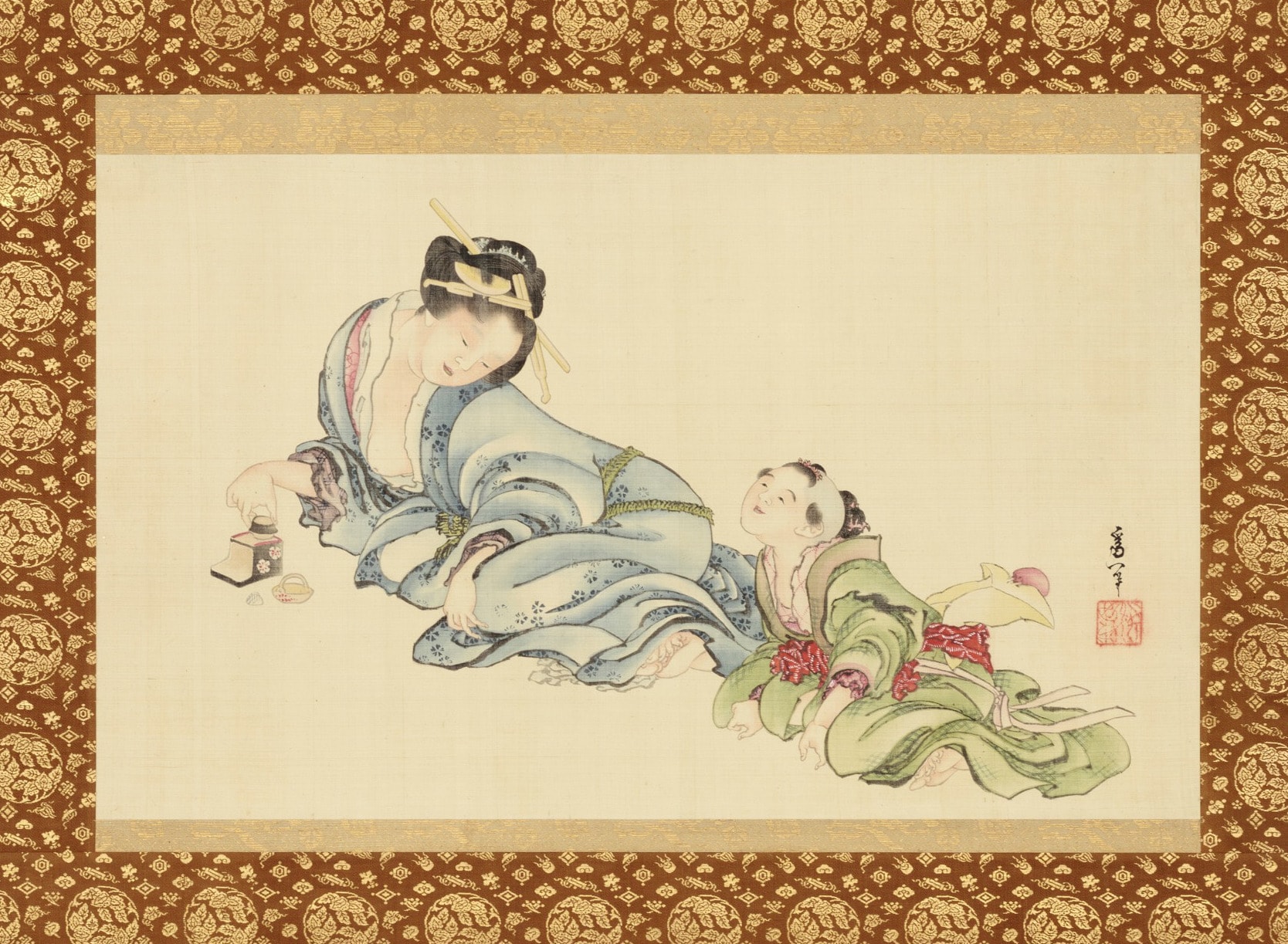
Mother and Child
母子図
35.9 × 59.5 cm
A mother and daughter at play, in the ukiyo-e lineage that made mother and child a subject of its own.
View this work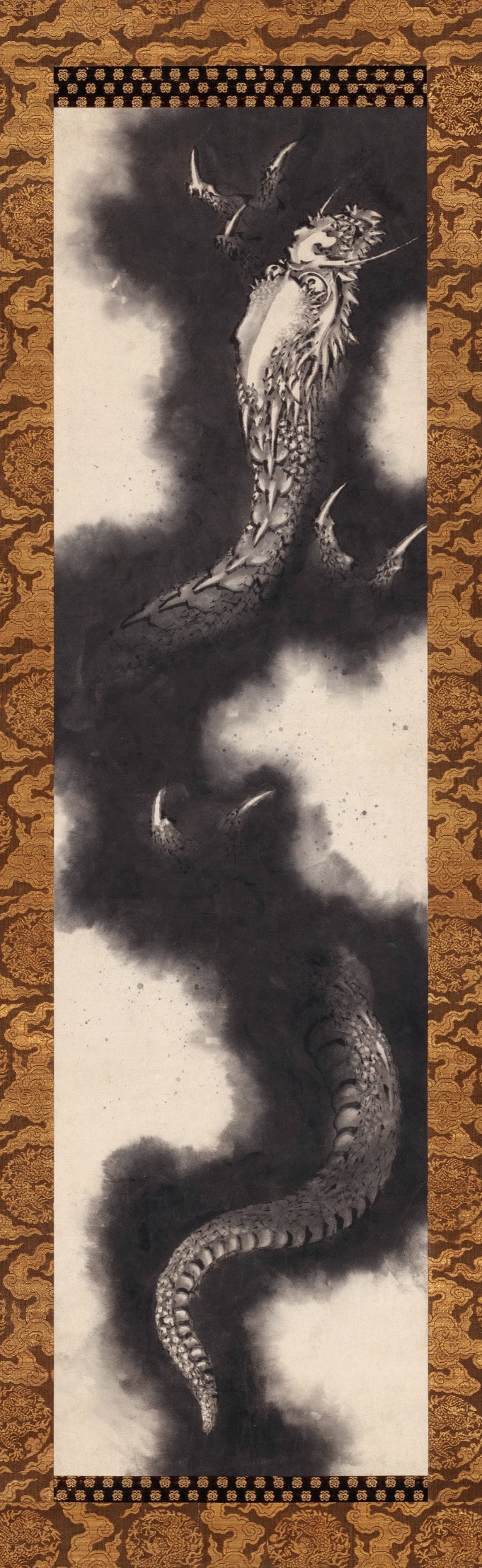
Ascending Dragon
昇龍図
102.4 × 27.9 cm
A subject he painted all his life; a companion descending dragon may once have existed.
View this work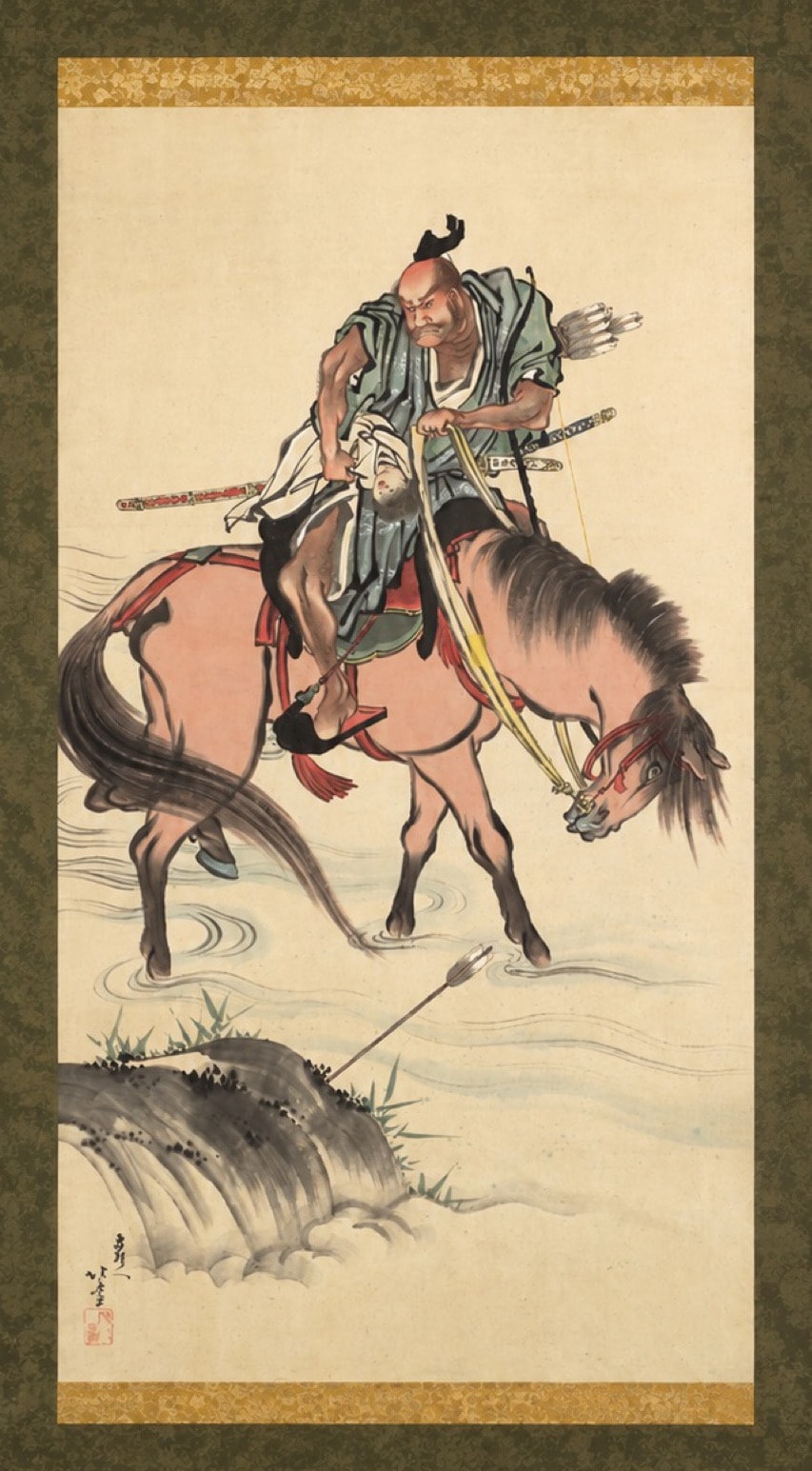
The Tale of Hiki Hangan Yoshikazu
比企判官能員物語図
108.7 × 55.1 cm
A large scroll, shown at Hokusai exhibitions around 1970. The title itself is still not settled.
View this work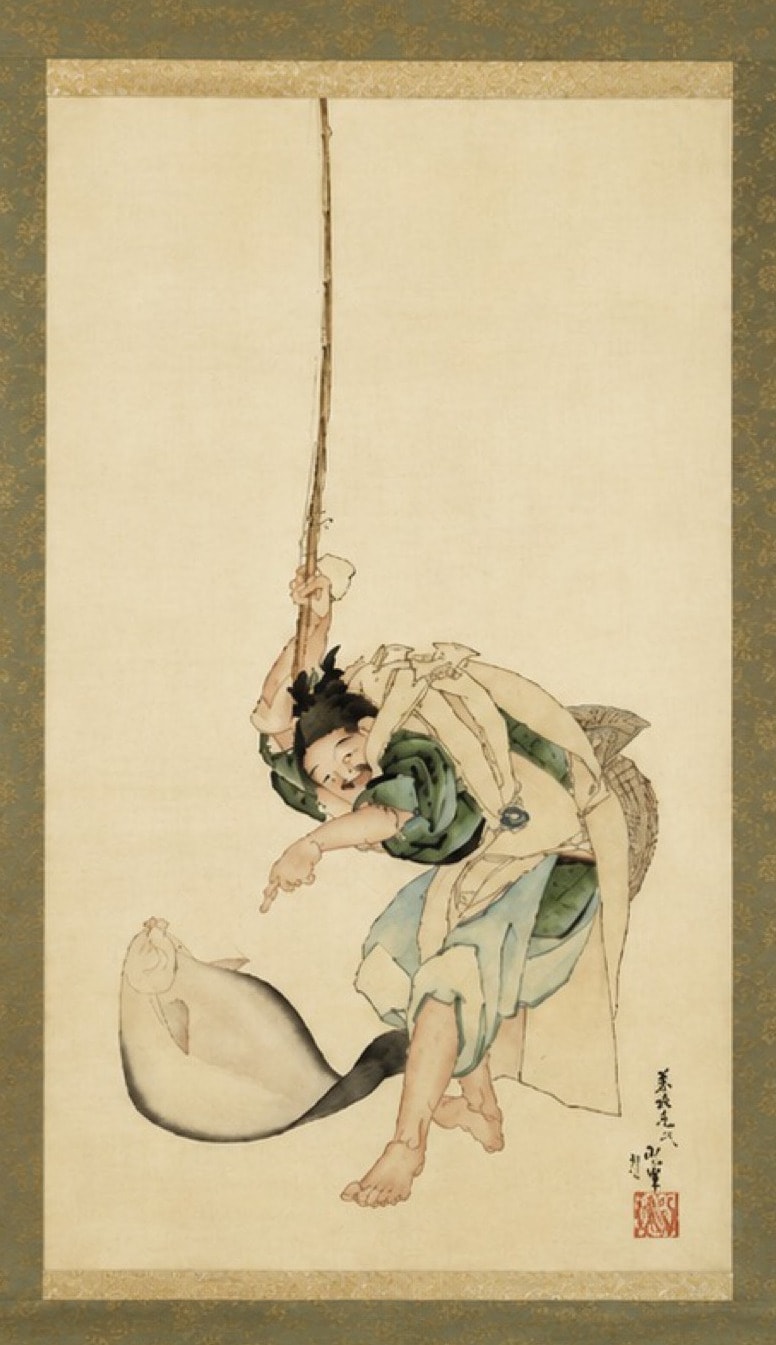
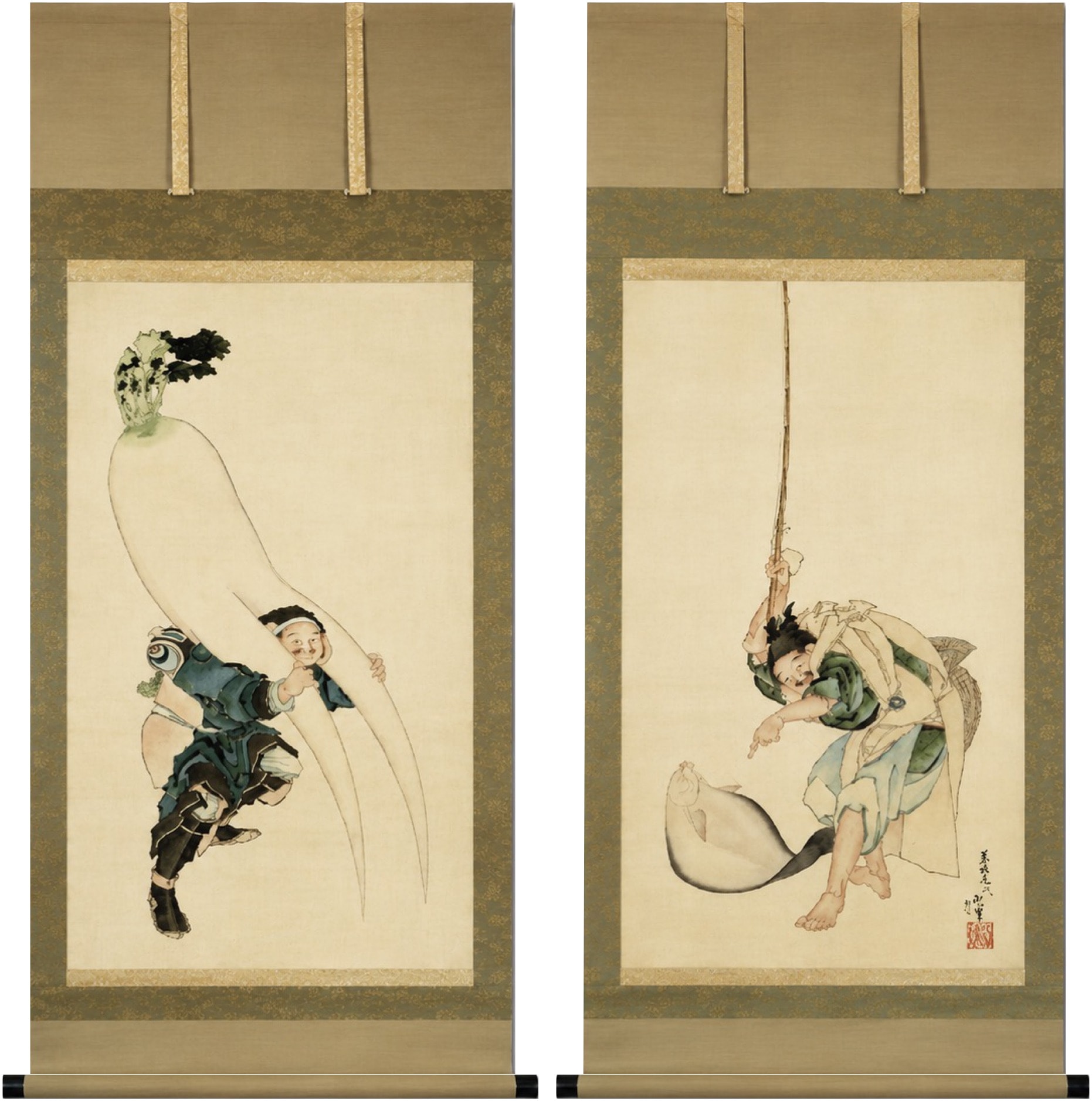
Daikoku with a Forked Radish / Ebisu with a Flounder (pair)
二股大根と大黒天/鮃と恵比寿天(双幅)
各73.0 × 30.8 cm
A pair. Only the Ebisu scroll is signed: “brush of Gakyo Rojin Manji, aged eighty.”
View this workIII
Fan Paintings
From his late seventies to eighty-three
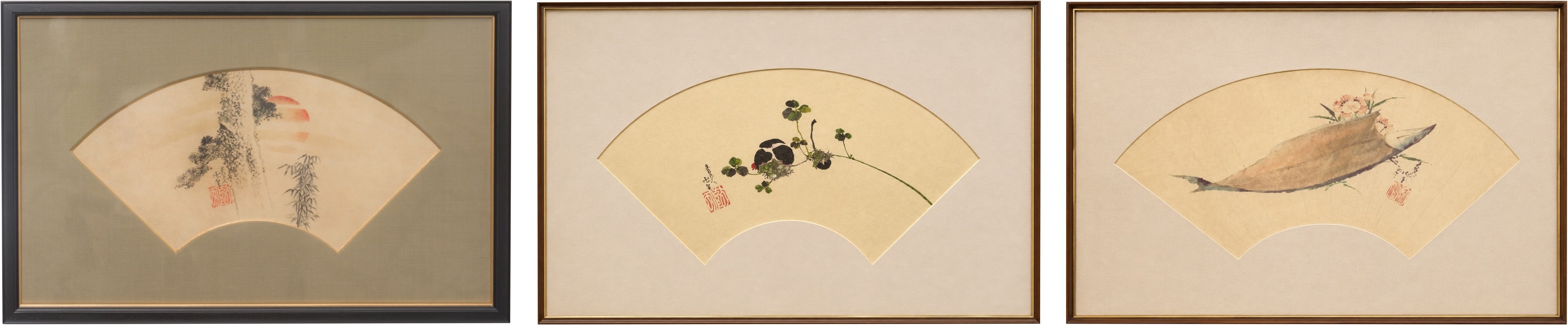
Three fans, from his late seventies to the age of eighty-three.
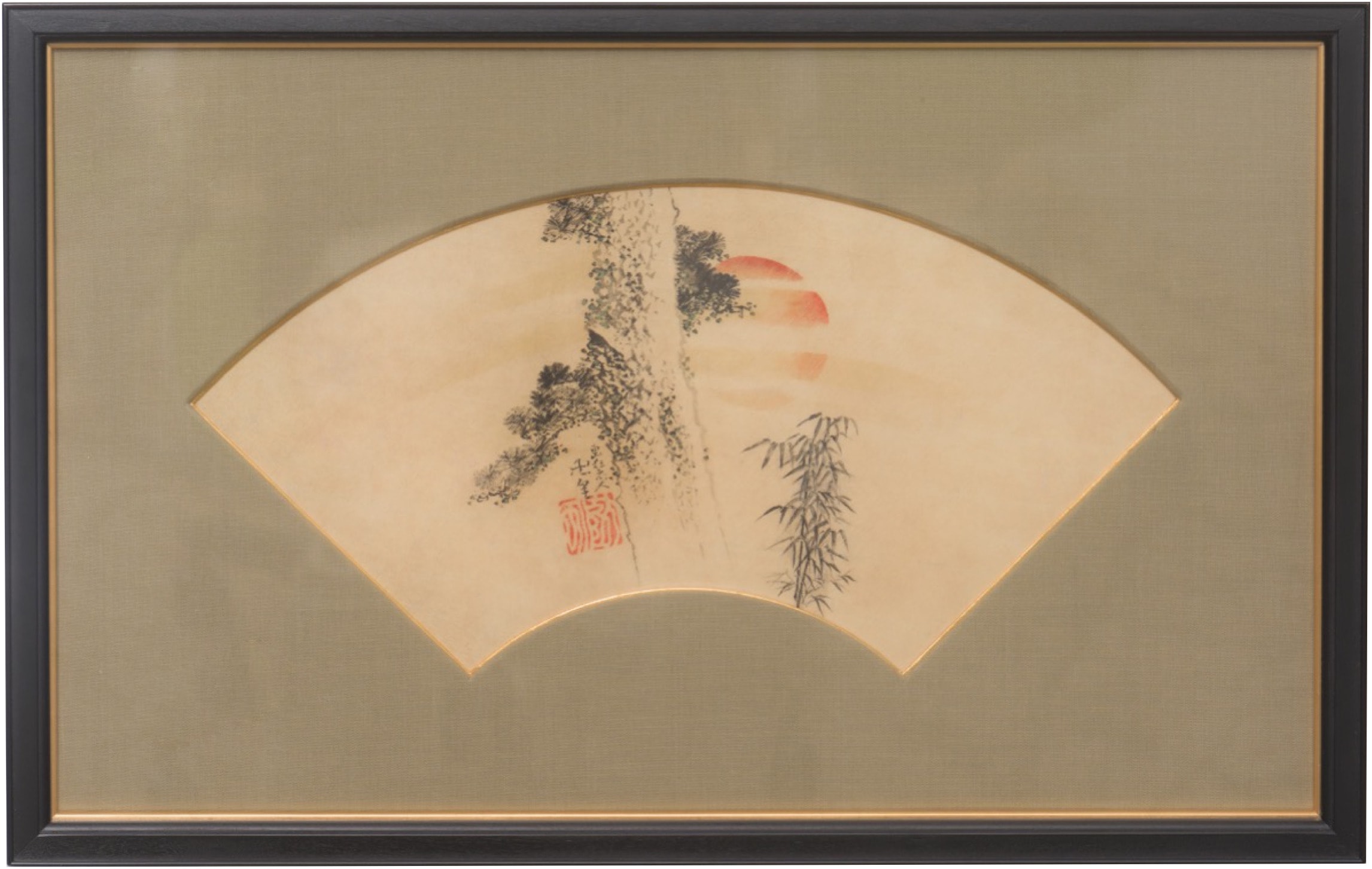
Rising Sun and PineSold
旭日と松図
Ink and colors on Japanese paper
Sold. Old pine, young bamboo and rising sun — auspicious motifs laid over one another.
View this work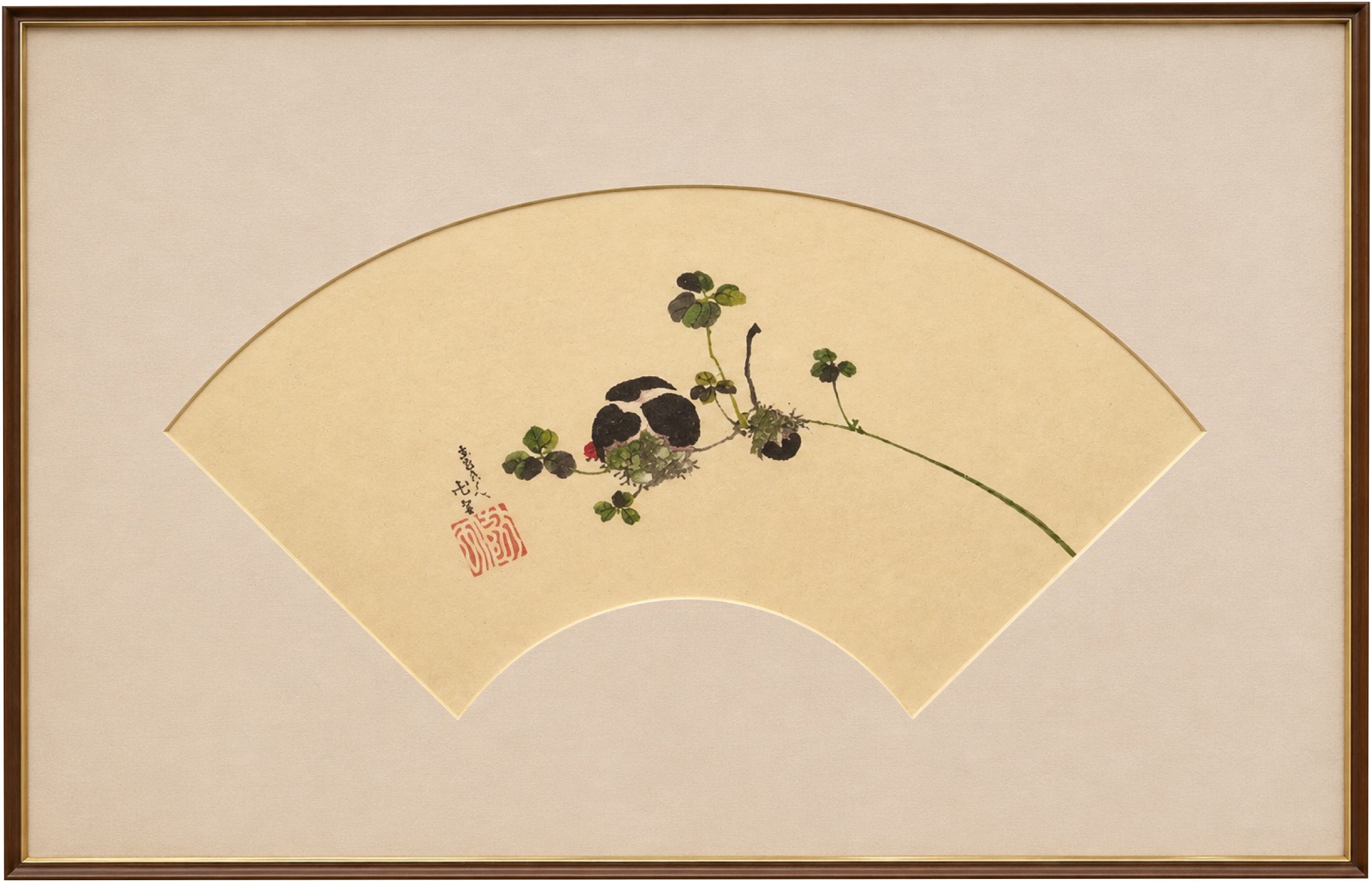
Small Eggplants and Wild Strawberries
小茄子に野苺図
Ink and colors on Japanese paper
A split fruit and a reaching vine: two forms that contain time.
View this work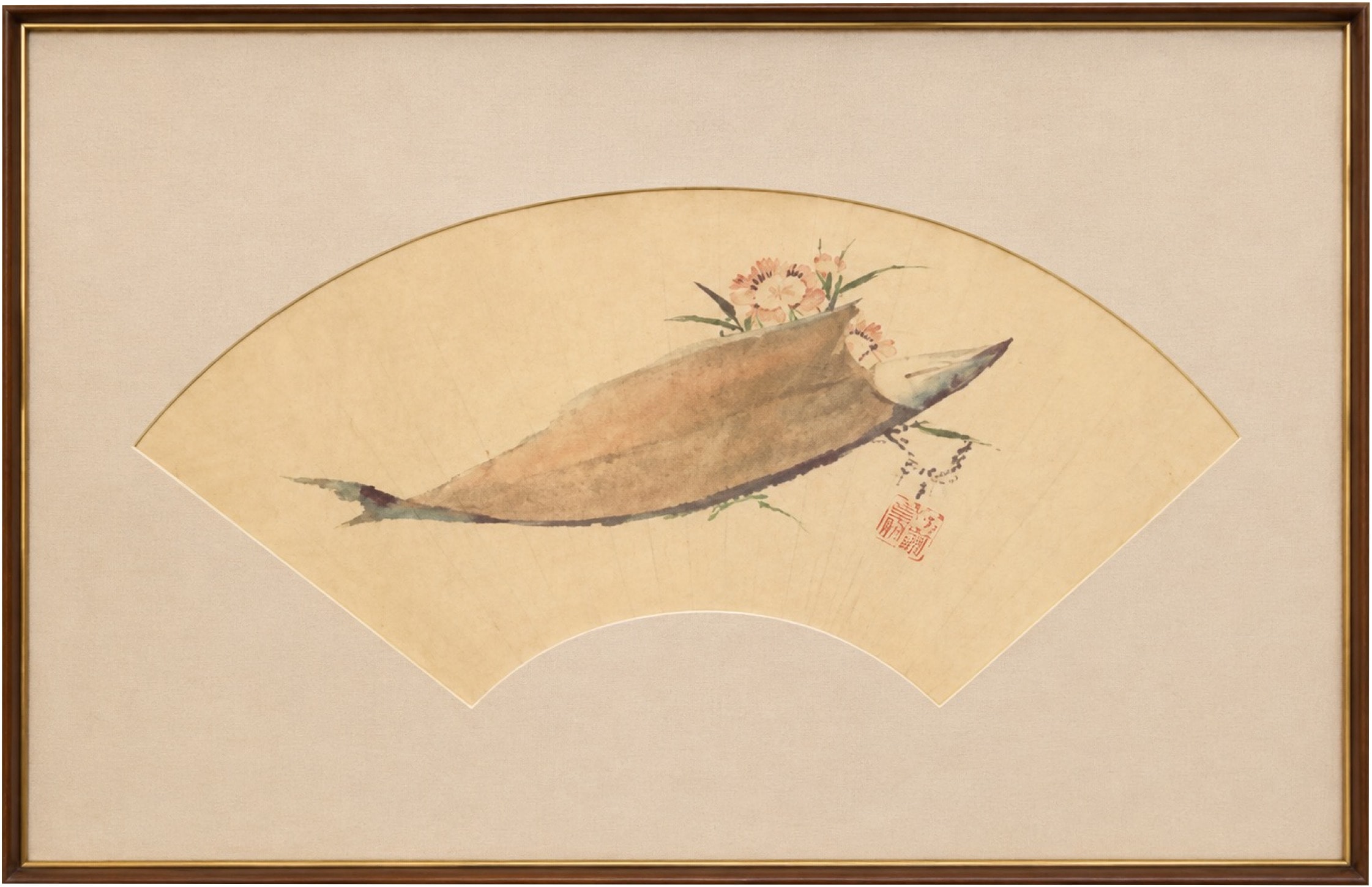
Dried Saury and Pinks
秋刀魚と撫子図
Ink and colors on Japanese paper
Painted at eighty-three; once owned by an American artist, and out of sight for some 120 years.
View this workIV
Thirty-six Views of Mount Fuji
Reprinted woodblock prints, mounted as scrolls
Not paintings. The designs are Hokusai's; the impressions are modern.
These three are not paintings from Hokusai's brush. The designs are his, but the sheets were printed in our own time: the International Hokusai Society supervised the colour, the Edo woodblock studio Takahashi Kobo pulled the impressions by hand, and each was mounted as a hanging scroll. Because they are different in kind from the twenty works above, we do not count them among the paintings. How they were made is set out in a separate article.
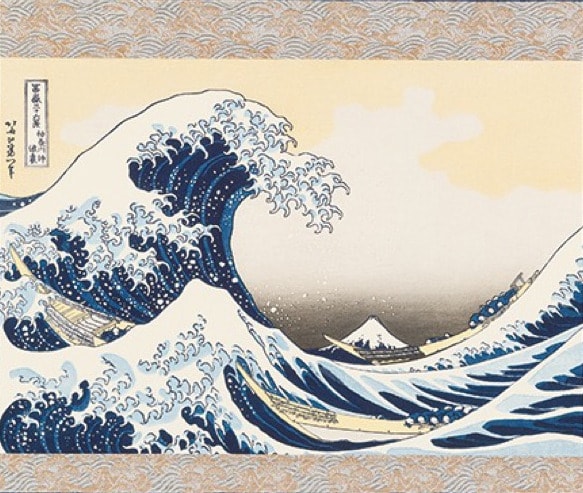
Under the Wave off Kanagawa
神奈川沖浪裏
Woodblock reprint, mounted as a hanging scroll
An indigo mounting, with a wave-pattern band above and below the sheet.
View this work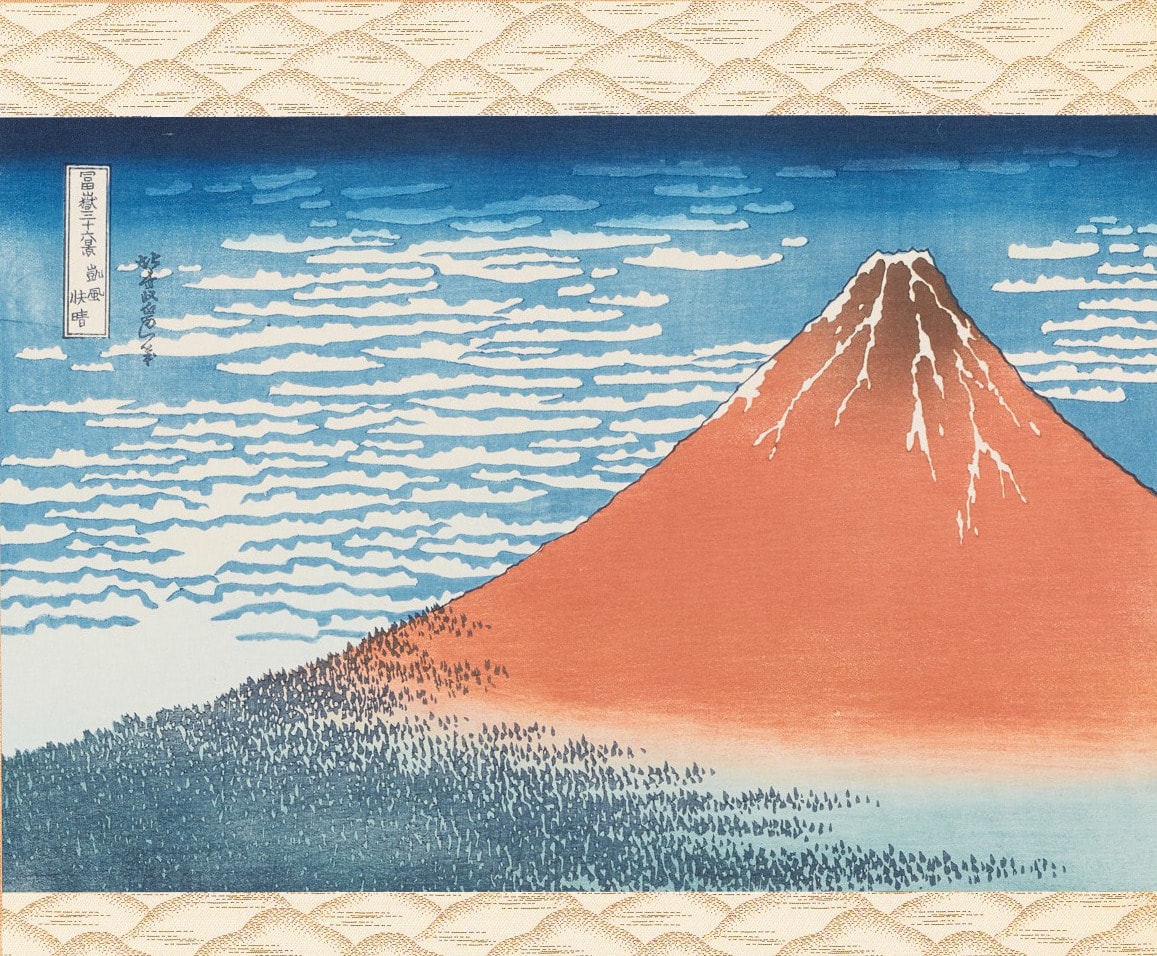
Fine Wind, Clear Morning
凱風快晴
Woodblock reprint, mounted as a hanging scroll
Fuji at the moment before it turns red — a picture of time passing.
View this work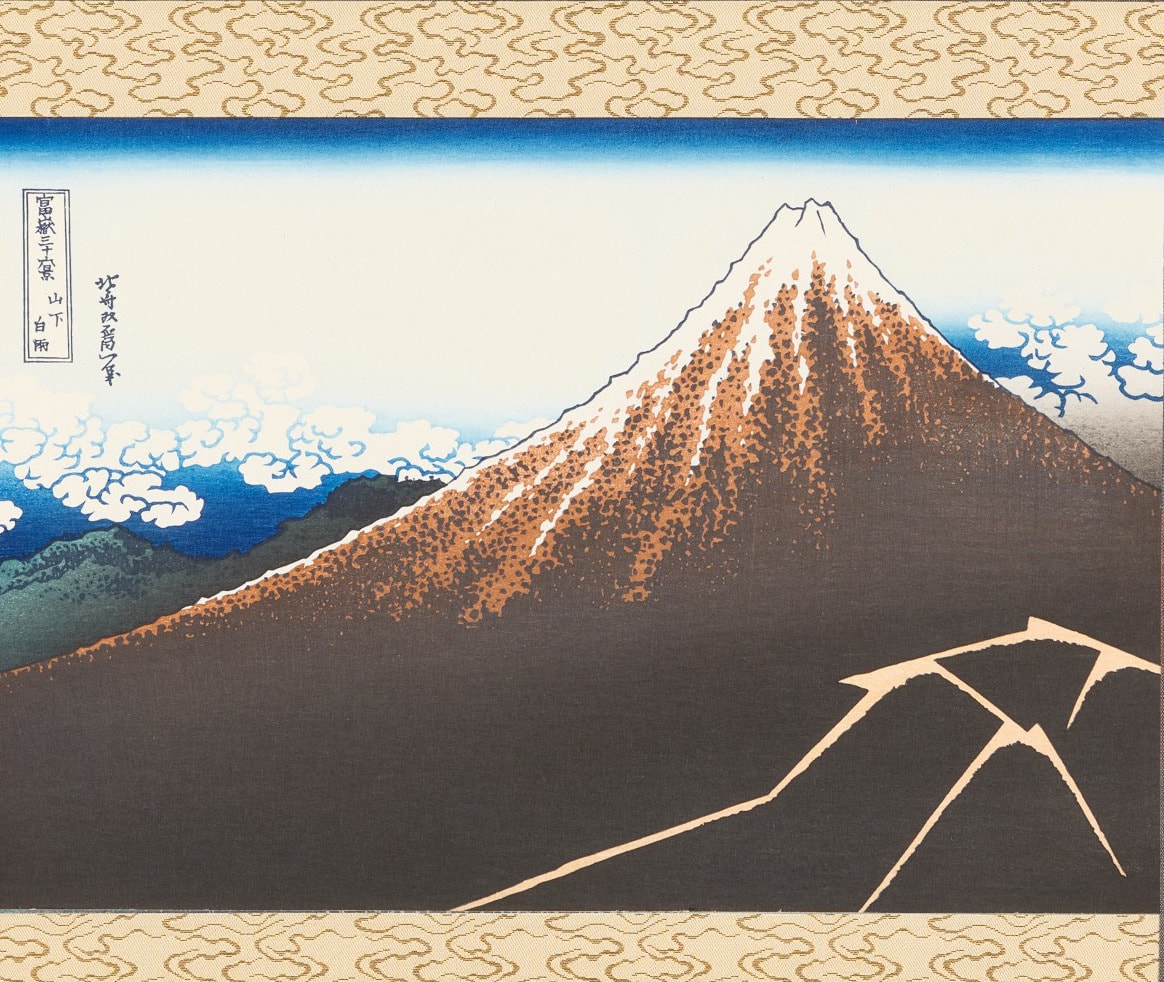
Rainstorm beneath the Summit
山下白雨
Woodblock reprint, mounted as a hanging scroll
Brightness at the summit, darkness below, and lightning running upward.
View this workOn acquiring one of these
Every work here is unique. We give prices and a detailed condition report in reply to an enquiry. If you would like to see a work in person, say so and we will arrange it.
Supervising editor
Yoshihisa EndoJapan Art Academy Representative Director
Born in Nishi-Azabu, Tokyo, in 1940. After graduating in French literature from Chuo University and a period in business, he founded a video production company. Negotiating directly with the Louvre, the Prado, the Hermitage and other museums, he filmed their collections in high definition for series such as The Museums of the World (1991), and published a multi-volume museum encyclopedia with twenty professors led by the art historian Seiro Maekawa.
He has produced or supervised more than a thousand television programmes on art (The World's Masterpieces on BS Asahi and Painter × Painter on BS Nippon TV among them), and his books include Letters from Vermeer and Lautrec and Mucha (Random House Kodansha) and a study of the Hokusai Manga (Kawade Shobo Shinsha). He is representative director of the Japan Art Academy (founded 2010) and a director of the International Hokusai Society (founded 2019). As a filmmaker he works under the name Hisashi Fuji.